
Why Coloured Gemstones Are Beating Stocks in 2026
Something is shifting in the world of investing. And if you pay attention to fine gems, you already felt it coming. Stock markets have been rattled in 2025 and into 2026. Geopolitical tensions, rate uncertainty, and a shaky tech sector have left many investors looking for somewhere else to put their money. Some went to gold. Some went to property. But a growing number of serious, wealthy collectors have turned to something far more interesting. Natural coloured gemstones.
And the numbers are impossible to ignore.
“At Christie’s, coloured gemstones have been trading at two to three times their high estimates. That is highly unusual. Auction houses calibrate their ranges with care.” — Industry analysts, 2026
Let me walk you through exactly what is happening, why it is happening, and what it means if you are thinking about gemstones as a serious investment.
The Auction Rooms Are Telling You Something
December 2025. Christie’s New York. A Tiffany and Co. necklace set with a rare blue Paraiba tourmaline and diamonds goes under the hammer. It sells for more than $4.2 million. That is ten times its low estimate.
A matching pair of earrings follows. Same result. Ten times estimate.
Jacqueline DiSante, Vice President and Head of Sales of Christie’s New York Jewellery Division, described the result as a clear marker of how far private clients are willing to go for exceptional goods.
This was not an isolated event. Across Sotheby’s and Christie’s sales in 2025, coloured gemstone lots were routinely exceeding pre-sale estimates by multiples, not percentages. A 12.59-carat Kashmir sapphire ring at Sotheby’s sold for $571,500 against an estimate of $100,000 to $200,000. A 7.50-carat Kashmir step-cut sapphire from the 1930s fetched $1.4 million against an estimate of $500,000 to $700,000.
These are not freak results. They reflect a pattern. And that pattern has a story behind it.
Why Investors Are Moving Away From Stocks
2026 has not been kind to traditional portfolios. Geopolitical tensions have kept markets volatile. Stock-bond correlations have broken down. The classic 60-40 portfolio strategy that worked for decades has been thrown into question.
BlackRock’s Spring 2026 Investment Directions report called for owning a broader basket of hedges including commodities and alternative assets. Fidelity analysts noted that the marketplace has underinvested in hard assets for a long period of time, favouring software and asset-light models instead.
Investors are waking up to the value of things you can hold. Things that exist in the physical world. Things that do not vanish when a server goes down or a central bank changes its mind.
Gemstones fit that description perfectly. They are portable. They are discreet. They do not generate income, but they do not require management either. And unlike stocks, they do not drop 30% overnight because a CEO sent a careless tweet.
Gemstones rise and fall based on rarity, style trends, and collector interest. They are not correlated to the S&P 500. That is exactly the point.
The Supply Problem That Nobody Is Solving
Here is something fundamental that most investors miss. You can print more money. You can mine more gold. You can produce lab-grown diamonds by the thousand. But you cannot create a new Kashmir sapphire deposit.
The Kashmir mines in northern India, which produced the finest blue sapphires the world has ever seen, are essentially exhausted. Mines stopped serious production in the early 1900s. The stones already in circulation are it. Full stop.
The same story plays out across fine coloured gems. Burmese rubies from the legendary Mogok Valley are rarer every year. The original Paraiba tourmaline deposits in Brazil are nearly depleted. Fine alexandrite from Russia is almost impossible to source in meaningful quantities.
When supply cannot grow and demand is rising, the mathematics are straightforward.
The global coloured gemstone market is projected to grow from around $38 billion in 2026 to $72.8 billion by 2036, according to Future Market Insights. That is a 6.6% compound annual growth rate. Fine natural stones sit at the premium end of that growth curve, and their supply is not keeping pace.
Rubies, Sapphires and Emeralds Are Leading the Charge
Not all gemstones are equal as investments. The market is separating very clearly into two tiers right now. At the top, you have investment-grade natural stones from prestigious origins. Fine rubies, sapphires and emeralds. These are the ones selling at multiples of estimate at auction. Dealers in London and New York report that demand for rare, richly saturated rubies from Mozambique and Burma was exceptional in 2025 and has continued strongly into 2026.
The Gems Driving the Most Attention Right Now
Sapphires
Blue sapphires from Kashmir, Burma and Sri Lanka continue to command the highest premiums. Kashmir sapphires are the gemological equivalent of a grand cru wine. The supply is legendary and finite. A 35.09-carat Kashmir sapphire called the Regent Kashmir sold at Christie’s Hong Kong in 2025 for $9.5 million.
Beyond classic blue, 2026 has seen serious collector appetite for padparadscha sapphires, the rare pinkish-orange variety from Sri Lanka, and yellow sapphires, which are gaining mainstream attention for the first time. Unheated sapphires of any origin are commanding premiums of 30 to 50 percent over comparable heated stones. Buyers at the serious end of the market are reading certificates more carefully than ever.
Explore Our Sapphire Collection → https://airagems.com/product-category/sapphire/
Rubies
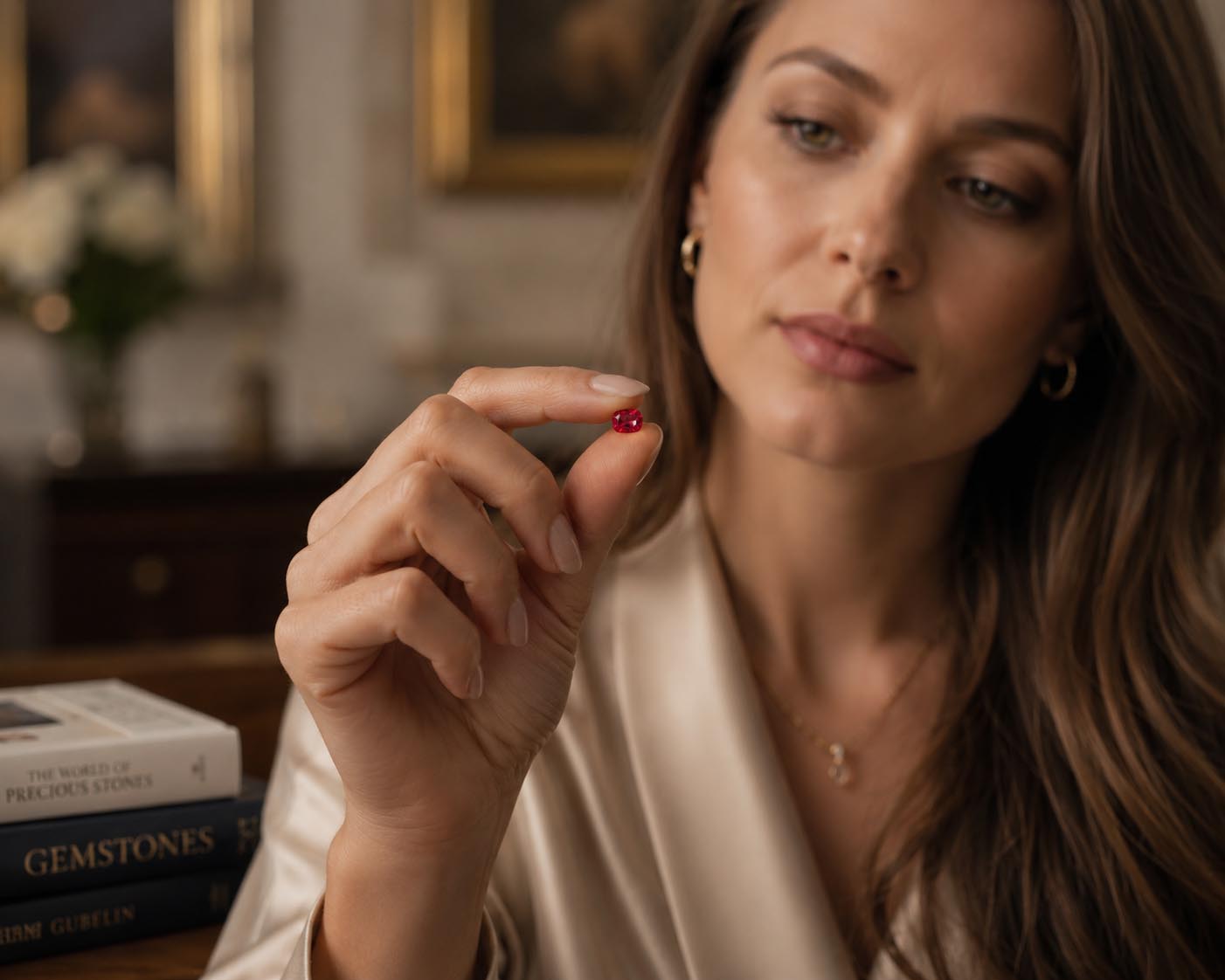
Fine untreated rubies above three carats are among the rarest gemstones on earth. The benchmark remains pigeon blood colour from Burma, but Mozambique rubies with certified origin are closing the price gap fast. Blockchain-backed provenance records from mines in Mozambique and Madagascar are giving buyers the transparency they now expect.
Industry analysts tracking the ruby market suggest the price trajectory through 2027 remains bullish. The secondary market for older Burmese stones is creating what dealers call a legacy effect, where historical pieces command astronomical prices because nothing comparable is being produced today.
Paraiba Tourmaline
This is the stone that is capturing the imagination of collectors in 2026. The copper-bearing tourmaline from Brazil produces a neon blue-green glow that no other gemstone can match. Original Brazilian deposits are nearly exhausted. African Paraibas from Mozambique and Nigeria exist but command lower premiums than their Brazilian counterparts.
When a Paraiba necklace sells for $4.2 million and a matching earring pair sells for the same multiple of estimate at Christie’s, the market is speaking clearly about where collector demand sits.
Spinel
If there is an undervalued play in the current market, many gemologists believe it is spinel. It is naturally untreated in most cases. It comes from prestigious origins including Burma, Tanzania and Tajikistan. And its price is still a fraction of comparable rubies or sapphires.
That will not last. When a gem combines natural beauty, no routine treatment, recognised provenance and rising demand, the price catches up. Collectors who bought spinel five years ago are already watching that happen.
The New Generation of Buyers Is Changing Everything
Here is something that surprised even seasoned auction house veterans. In 2025, millennials and Gen Z buyers accounted for 44% of Christie’s luxury purchasers. This is the next generation of wealthy consumers, and they are approaching fine jewellery with exactly the same investment mindset as their predecessors.
They are also driving the ethical sourcing conversation. Younger buyers want to know where a stone came from. They want treatment disclosures. They want certification from GIA, Gubelin or SSEF. They are not willing to pay premium prices for a stone with no paperwork. This transparency demand is actually good for values at the top end, because it separates genuine investment-grade stones from the mass market.
Celebrities have played a role too. Kate Middleton, Halle Berry and Eva Longoria have all been seen wearing coloured gemstone engagement rings. An estimated 15% of engagement rings today feature a coloured gemstone. A decade ago that figure was 5%. The cultural shift toward colour is structural, not seasonal.
Lab-Grown Stones Are Actually Helping Natural Gems
Lab-grown diamonds are now common. Prices have dropped dramatically. And as they became more accessible, something interesting happened to natural coloured gemstones. They became more desirable.
The reason is simple. A ruby or sapphire cannot be replicated the way a diamond can. Each natural coloured stone has inclusions, the minerals trapped inside during formation, that give it a distinct character no laboratory can reproduce. Those inclusions are its fingerprint. In many cases they enhance rather than reduce value, because they tell the story of the stone’s origin and natural formation.
As buyers grow more familiar with the difference between synthetic and natural, the premium on genuinely rare, genuinely natural coloured stones only grows.
Unlike stocks which shift with earnings reports, or gold which reacts to policy changes, gemstones derive value from a combination of geological scarcity, cultural desirability, and collector passion. That is a different kind of resilience.
What This Means If You Are Thinking About Buying
I want to be direct here. Gemstones are not a liquid investment. You cannot sell a sapphire as easily as you sell a stock. The market rewards patience. And the spread between buy and sell prices can be significant.
But for long-term holders with a 5 to 10-year horizon, the fundamentals are stronger in 2026 than they have been in a long time. Here is what matters most if you are thinking about entering this market.
- Buy certified stones only. GIA, AGL and Gubelin are the names that matter.
- Prioritise unheated and untreated stones. The premium is real and growing.
- Origin matters enormously. Kashmir sapphire, Burmese ruby, Colombian emerald, Brazilian Paraiba. Learn the hierarchy.
- Bigger is exponentially rarer. A 5-carat sapphire is not simply five times the value of a 1-carat stone. It is a multiple of that.
- Work with reputable dealers and buy at recognised auction houses when possible. Provenance is everything.
The Bottom Line
Markets are uncertain. Stocks are volatile. The traditional 60-40 portfolio is creaking under pressure it was never designed for.
Meanwhile, a Paraiba tourmaline necklace just sold for 10 times its auction estimate. Kashmir sapphires are fetching $92,000 per carat. Unheated Burmese rubies are creating bidding wars in Geneva and Hong Kong.
Coloured gemstones are not a get-rich-quick play. They never were. But for investors who understand rarity, who appreciate the beauty of a natural stone, and who are thinking in decades rather than quarters, 2026 is proving to be a remarkable moment to pay attention.
The earth stopped making these stones millions of years ago. The demand for them is only growing.
That is not a market trend. That is geology.