
The June Birthstone Story
Most months get one birthstone. June gets three. That alone makes June worth paying attention to if you care about gems, because pearl, alexandrite, and moonstone are so different from each other that calling them companions feels a little strange. They do not look alike, do not form alike, and do not behave alike. What they share is a calendar month and a reputation for being some of the more unusual and memorable stones in the world.
The reason June ended up with three options goes back to revisions made to the traditional birthstone list over several decades. The Jewelers of America updated the official list in 1952, adding alexandrite for June alongside pearl. Moonstone, with its long European history, was later included as a third alternative. The result turned June into arguably the most interesting birth month for anyone who cares about gemstones.
This guide covers what each stone actually is, what makes it special, how to buy it, and why each one holds its own as both a piece of jewellery and a serious long-term asset.
Pearl: The Only Gemstone Made by a Living Creature
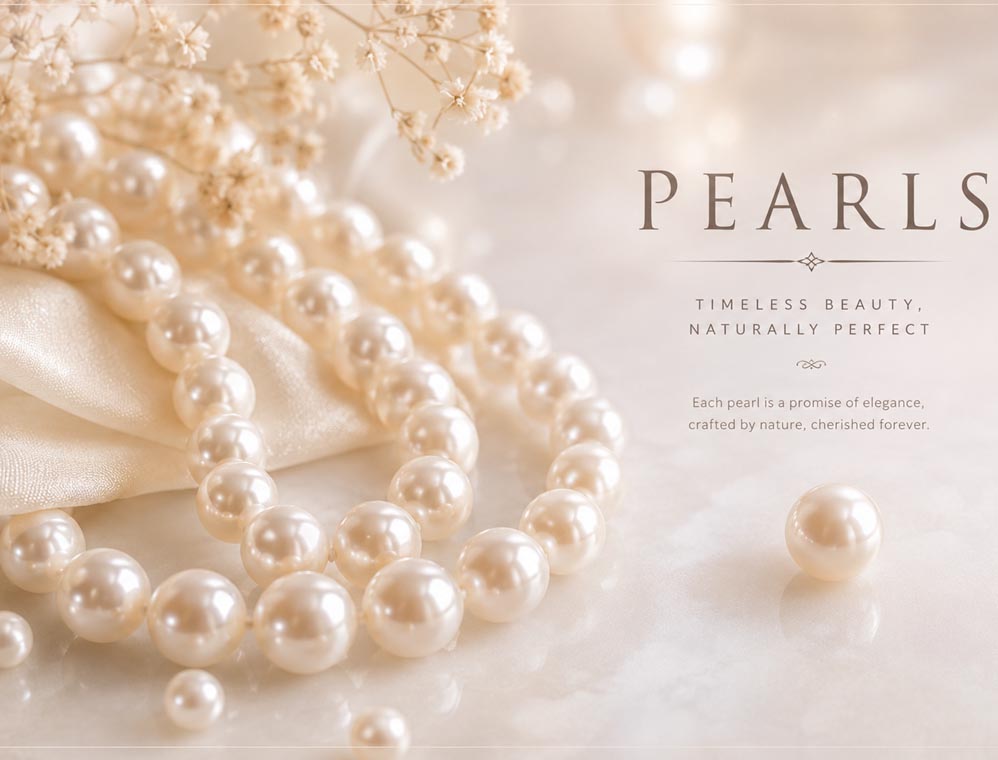
Pearl sits at the top of most June birthstone lists, and it has held that position for centuries. The reason people keep coming back to pearl is not just tradition. It is the fact that pearl is genuinely unusual — not because of rare chemistry or optical tricks, but because of how it forms.
When a mollusk — typically an oyster or mussel — encounters an irritant inside its shell, it begins coating that irritant with layers of nacre. Nacre is a compound of calcium carbonate and protein, and it builds up layer by layer over months or years. Those accumulated layers become what we call a pearl. The whole process is biological, not geological. Pearl is the only gemstone that comes from a living organism, which already sets it apart from everything else in a jeweller’s cabinet.
Natural pearls — meaning pearls formed in the wild without human intervention — are genuinely rare today. Almost all pearls sold commercially are cultured, meaning a technician has deliberately introduced an irritant to prompt nacre production. Cultured pearls are real pearls in every meaningful sense, but the distinction matters if you are buying for investment or seeking something with authentic provenance.
For quality assessment, the most important factor is lustre. A high-lustre pearl has a mirror-like depth to its surface, as if you are looking into the stone rather than at it. Surface quality, nacre thickness, and shape follow from there. Perfectly round pearls command a premium, though baroque and semi-baroque shapes are increasingly popular for their organic character. Always ask about nacre thickness when buying Akoya pearls specifically — thin nacre peels over time and loses lustre.
Symbolically, pearls have long been associated with purity, wisdom, and quiet elegance. In many Asian cultures they represent good luck and prosperity. In the West, they became synonymous with formality, which is why they still appear consistently at state events and on red carpets. The cultural weight pearls carry is real, and it has held up for a very long time.
Pearl quick facts:
- Origin: Marine and freshwater mollusks — oysters, mussels, clams
- Hardness: 2.5–4.5 Mohs (soft — keep away from harder gemstones in storage)
- Colours: White, cream, pink, silver, gold, green, and black (Tahitian)
- Top sources: Japan (Akoya), French Polynesia (Tahitian black), Australia (South Sea), China (freshwater)
- Symbolism: Purity, wisdom, loyalty, and long-term prosperity
Pearl is among the softest gemstones commonly set in jewellery. Store pearls separately, away from diamonds and other hard stones. Clean with a damp soft cloth only — chemicals, ultrasonic cleaners, and even perfume will damage the nacre surface over time
Alexandrite: The Gemstone That Changes Colour in Different Light
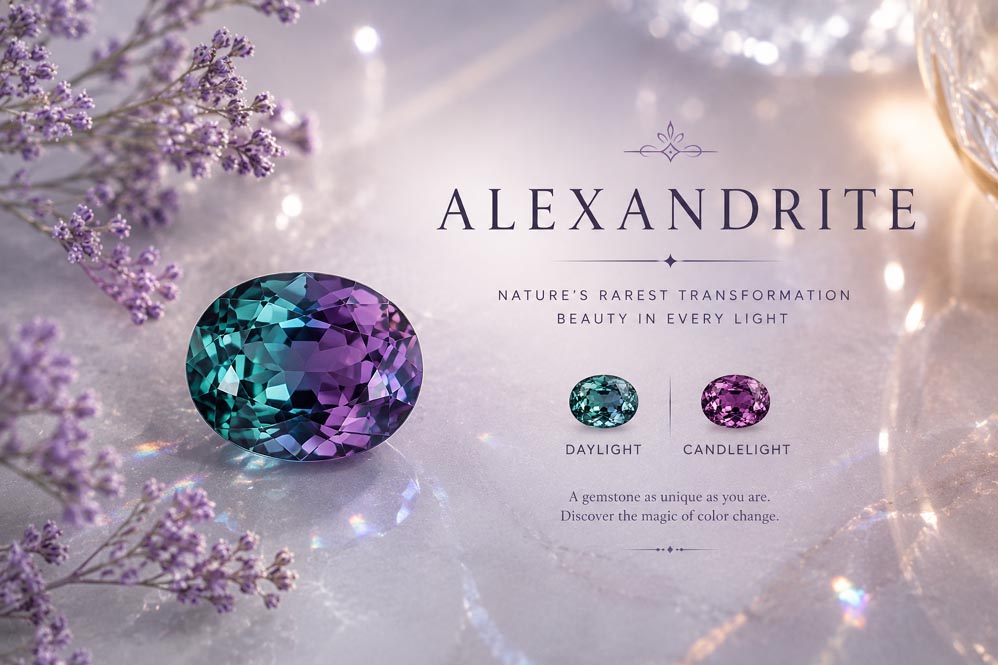
If you have never seen a fine alexandrite in person, the description can sound exaggerated. Green in daylight. Red under incandescent light. The shift is dramatic enough that it looks like two completely different stones depending on where you stand.
That optical effect — the alexandrite effect — results from how chromium within the crystal structure absorbs light. The human eye interprets the remaining reflected wavelengths differently under natural versus incandescent sources. A good stone shifts from a vivid green or teal in sunlight to a rich red or purplish-red under a lamp. The stronger and cleaner that shift, the more valuable the stone.
Alexandrite was first identified in the Ural Mountains of Russia in the early 1830s. The discovery is traditionally linked to Tsar Alexander II’s birthday, which is where the name originates. Original Russian specimens showed a remarkably strong colour change — vivid green to deep red — and those stones remain the benchmark against which all alexandrite is measured. Genuine fine-quality Russian alexandrite is exceptionally rare and commands prices that reflect that scarcity.
Modern alexandrite comes from Brazil, Sri Lanka, East Africa, and India. The colour change in many of these deposits is softer than the classic Russian material. When buying, the strength and quality of the colour change matters more than almost anything else. A stone with a weak shift — grey-green to brownish-purple — is a lesser stone regardless of size or clarity.
For collectors and investors, alexandrite is one of the more compelling coloured gemstones on the market. Fine specimens over two carats are genuinely difficult to source, and no new deposits have emerged at a rate that keeps pace with international demand. The gemological community considers it one of the most important precious stones alongside ruby, sapphire, and emerald, though far fewer buyers have encountered it — which creates an interesting position for those who value rarity over name recognition.
Alexandrite quick facts:
- Mineral family: Chrysoberyl (BeAl₂O₄ with chromium)
- Hardness: 8.5 Mohs — excellent durability for daily wear
- Colour change: Green to teal in daylight / red to purple-red under incandescent light
- Top sources: Russia (Urals), Brazil, Sri Lanka, East Africa
- Symbolism: Good fortune, intellectual clarity, and balance
- Investment note: Fine specimens over 1 carat with strong colour change are among the most sought-after coloured gemstones in the current market
Fine alexandrite is rarer than ruby, emerald, and sapphire at comparable quality levels. That rarity is not a marketing claim — it reflects the extremely specific geological conditions required for chromium-bearing chrysoberyl to form. Supply from the original Russian deposits is exhausted, and the global market has never found a replacement source of equivalent quality.
Moonstone: The Stone That Seems to Glow From Within
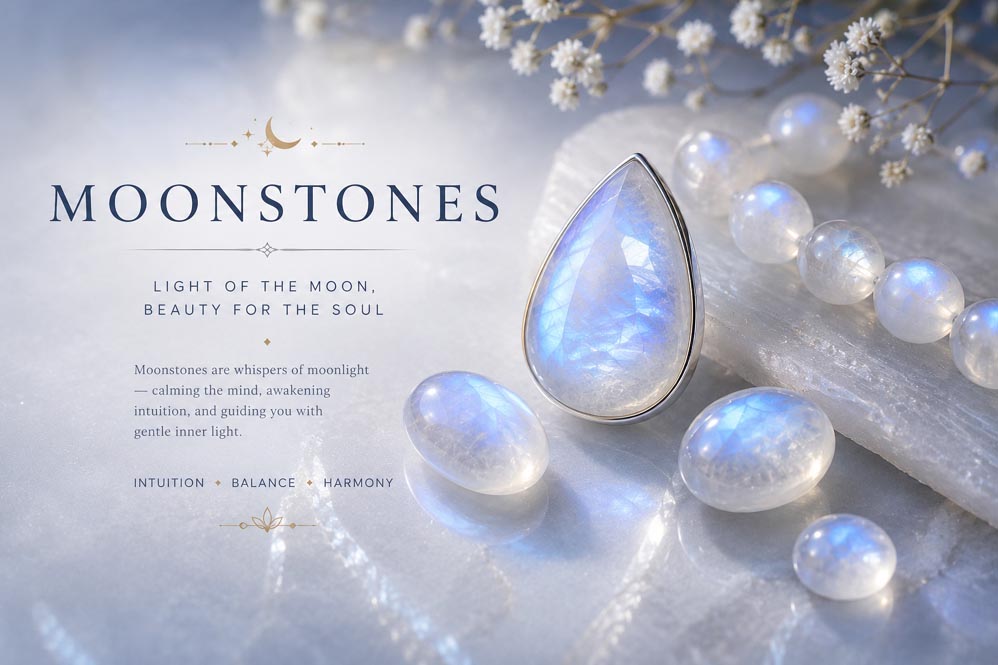
Moonstone gets its name from the visual effect it produces — a floating, billowing light that appears to move inside the stone as it is turned. Gemologists call this adularescence, and it comes from the way light scatters between thin alternating layers of feldspar minerals within the stone’s structure. The result looks like moonlight reflected on still water, and once you have seen a fine specimen in person, the name makes complete sense.
The finest moonstones come from Sri Lanka, where the classic blue-sheen variety is found — almost transparent, with a vivid electric-blue adularescence that floats across the surface when the stone is moved. India produces a wide range of moonstones in beige, brown, and orange tones with what is called rainbow adularescence. Myanmar, Madagascar, and Tanzania also contribute commercial quantities to the international market.
Moonstone has a long history in jewellery and culture. The Romans believed it was solidified moonbeams. In Hindu tradition it is considered sacred, connected to the lunar deity Chandra. During the Art Nouveau period, designers used it extensively in organic, flowing pieces. It came back into popular use in the 1960s and has remained a fixture of artisan and studio jewellery ever since.
When buying moonstone, the adularescence should be centred — the billowing light should float in the middle of the stone rather than near the edge. Blue adularescence is the most prized. The body colour should ideally be as transparent and colourless as possible for the classic Sri Lankan variety. Avoid stones with visible cracks, as moonstone’s tendency toward cleavage makes these structural weak points.
One practical point: moonstone sits at 6 to 6.5 on the Mohs scale, which makes it softer than most popular gemstones. Rings with moonstone centres need protective settings, and the pieces need more careful handling than you would give a sapphire or diamond. Earrings and pendants are the more practical format for everyday moonstone wear.
Moonstone quick facts:
- Mineral family: Feldspar group (orthoclase and albite intergrowth)
- Hardness: 6–6.5 Mohs
- Colours: Colourless, white, peach, grey, brown, green, blue — adularescence varies by origin
- Top sources: Sri Lanka (blue sheen), India (rainbow), Myanmar, Madagascar
- Symbolism: Intuition, new beginnings, femininity, and emotional balance
- Best worn as: Earrings, pendants, and brooches — protect from hard impact in ring settings
Comparing the Three June Birthstones at a Glance
Each of the three June birthstones suits a different buyer. Pearl is the classic and established choice — formal, cultural, and with a long track record in fine jewellery. Alexandrite is the rare collector’s stone, best suited to buyers who understand the market and value exclusivity. Moonstone is the more personal, artisan-oriented option — less about investment, more about the visual experience of wearing it.
On durability, alexandrite is by far the most practical for everyday wear at 8.5 Mohs, followed by pearl (which is soft but widely set in protected formats like pendants and drop earrings), and moonstone (which needs protective settings for rings). On rarity, fine alexandrite stands alone — there is genuinely no equivalent stone as scarce at comparable quality levels. On symbolism and cultural depth, pearl carries the longest and most globally recognised history.
June Birthstones as Long-Term Assets
All three stones have genuine investment cases, though each operates differently.
Natural pearls — wild-harvested specimens rather than cultured — have become increasingly rare as pollution and habitat loss reduce wild mollusk populations. Antique natural pearl strands in fine condition have held value consistently at auction over the past two decades. Cultured pearls, while beautiful, do not carry the same investment profile due to abundant supply.
Alexandrite presents the strongest new-purchase investment case. Supply from the original Russian deposits is exhausted, and no other source has matched that material’s quality. A well-documented, fine-quality alexandrite with GIA certification represents a genuinely scarce commodity. The market for top alexandrite at major auction houses has strengthened considerably over the past decade, and stones above one carat with strong colour change continue to appreciate.
Moonstone
operates more as a jewellery investment than a pure gemstone investment. High-quality antique moonstone pieces — particularly Art Nouveau jewellery featuring fine Sri Lankan blue moonstones — retain value well. As a raw stone investment, the market is thinner and less liquid than alexandrite or fine pearl.
A Few Final Thoughts
June’s three birthstones each connect to something genuinely distinct. Pearl connects you to a living world — every pearl is a record of a biological process that took years to complete. Alexandrite connects you to geological rarity and a very specific window of earth chemistry that is not being replicated. Moonstone connects you to a quiet visual experience that rewards the wearer over time rather than dazzling from across a room.
Any one of the three is a serious choice. Together, they give anyone born in June a range that almost no other birth month can match. The question is not which one is best — it is which one suits the person wearing it.