
Sapphires as an Investment
Why Sapphires Deserve a Place in Your Investment Portfolio
In a world of volatile equity markets, currency fluctuations, and inflationary pressures on traditional asset classes, sophisticated investors are increasingly looking beyond stocks and bonds to preserve and grow their wealth. Among tangible alternative assets, investment-grade sapphires have emerged as one of the most compelling and time-tested stores of value available to private investors and institutional collectors alike.
Unlike gold, which trades as a homogenous commodity, or equities that can be rendered worthless overnight, a fine sapphire is a rare, irreplaceable, and infinitely portable asset that has held its value across civilizations, centuries, and economic cycles. The finest examples have not merely held value; they have appreciated dramatically over the past two decades, in many cases outperforming traditional investment benchmarks.
This article examines, from a gemological and market perspective, the case for including certified sapphires in a serious investment portfolio. We will analyze the price trends of the past twenty years, identify the characteristics that drive maximum value appreciation, highlight the origins commanding the highest premiums, and provide practical guidance on where to source investment-quality stones at the most favorable prices.
Key Market Indicator
The global colored gemstone market is projected to grow at a compound annual growth rate of approximately 11% through 2030, driven by expanding wealth in Asia, declining natural supply, and growing demand for ethical, traceable alternatives to diamonds. Within this market, certified sapphires from premium origins represent the strongest long-term appreciation story.
Twenty Years of Sapphire Price Appreciation: 2005 to 2025
The story of sapphire prices over the past two decades is one of consistent, structural appreciation interrupted only briefly by global economic disruptions and always followed by a rapid recovery and fresh upward momentum. The drivers of this appreciation are not speculative; they are rooted in the immutable geology of the earth, the finite supply of gem-quality corundum, and the relentlessly expanding global appetite for fine colored stones.
The Early Growth Phase: 2005 to 2012
At the beginning of the twenty-first century, investment-grade sapphires were already commanding substantial prices at leading auction houses, but the broader collector and investor market was still developing the infrastructure to participate meaningfully. The establishment of standardized grading reports by institutions such as the Gemological Institute of America (GIA) and the Swiss Gemmological Institute (SSEF) during this period began to transform sapphires from beautiful objects of desire into credible, transferable financial instruments.
Between 2005 and 2012, top-quality Kashmir sapphires rose from approximately USD 8,000 to 20,000 per carat to over USD 35,000 per carat for fine examples. Ceylon sapphires from Sri Lanka, historically the most prolific source of commercial- and investment-grade stones, saw comparable percentage gains as international awareness of origin premiums took hold. The Blue Belle of Asia, a 392.52-carat Sri Lankan sapphire, sold at Christie’s Geneva in 2014 for over USD 17 million, establishing a world record and signaling to the global investment community that large certified Ceylon stones held extraordinary capital value.
The Acceleration Phase: 2013 to 2020
The decade spanning 2013 to 2020 represented a period of dramatic price acceleration for investment-grade sapphires, particularly for stones from classic origins with GIA or SSEF certification confirming no heat treatment. Several structural forces converged to drive this appreciation.
First, the explosive growth of high-net-worth individuals in China, Singapore, Vietnam, India, and the broader Middle East introduced an entirely new and culturally motivated buyer base for fine colored stones. Asian collectors have historically exhibited strong preferences for sapphires and rubies, viewing them as symbols of wealth, protection, and dynastic continuity. The scale of new buyers entering the market from 2010 onward represented a fundamental, permanent demand shift rather than a cyclical trend.
Second, the supply of genuinely fine, unheated sapphires from the most prestigious origins became structurally constrained. Kashmir, the most prestigious sapphire origin on earth, ceased meaningful production in the early twentieth century. The best Burmese mines in the Mogok Valley are increasingly depleted. Even Sri Lanka, which has produced sapphires for over two thousand years, is finding its richest deposits significantly more challenging to mine, with top-quality unheated stones representing a diminishing proportion of total production.
The Post-Pandemic Surge: 2021 to 2025
The period from 2021 to 2025 saw perhaps the most dramatic price appreciation in the history of the modern sapphire market. Supply chain disruptions caused by the COVID-19 pandemic severely restricted access to mining regions and international gem fairs, temporarily reducing supply just as pent-up demand from wealthy buyers reasserted itself. Simultaneously, inflationary pressures globally accelerated investor interest in tangible, portable stores of value.
Kashmir sapphires gained between 40 and 70 percent in value from 2020 to 2025 as Asian demand expanded and the supply remained permanently and geologically fixed. Investment-grade Ceylon sapphires with GIA certification showing no heat treatment appreciated by 30 to 50 percent over the same period. The market data confirms consistent annual price appreciation of 5 to 8 percent for standard investment-quality sapphires, with exceptional specimens from preferred origins achieving substantially higher returns.
Sapphire Price Evolution: 2005 to 2025
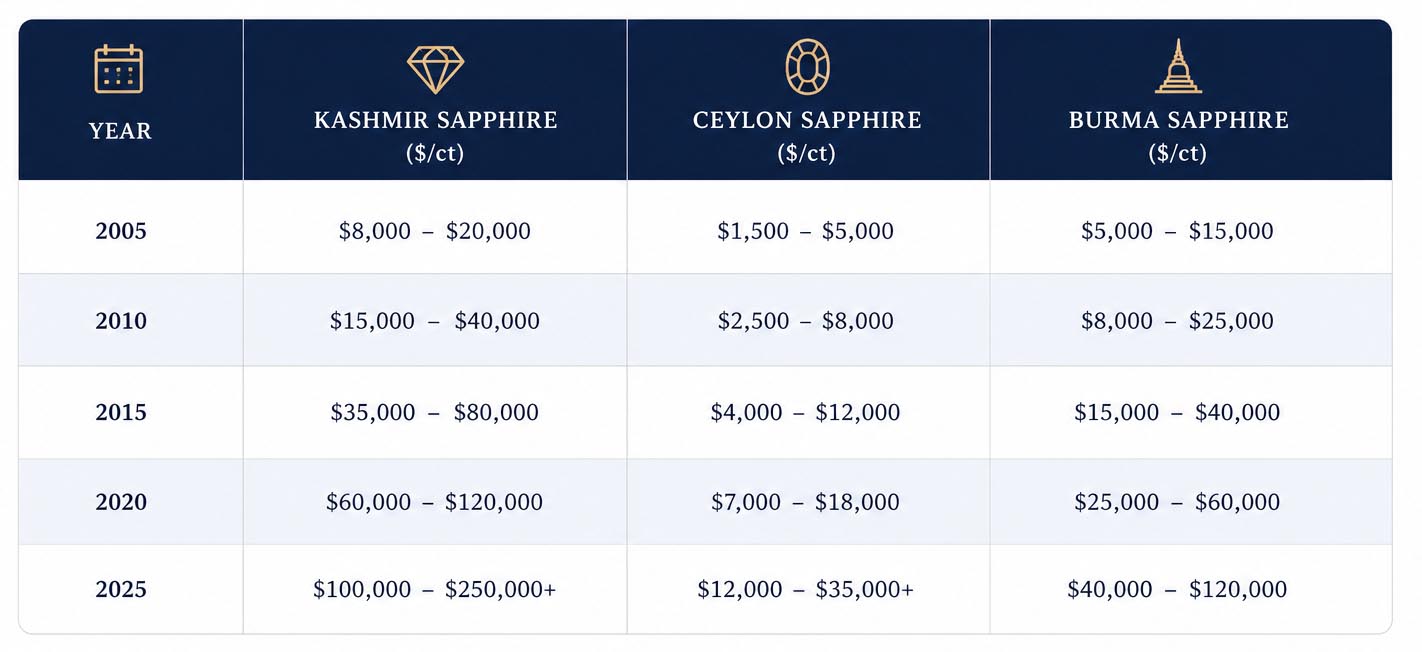
Estimated per-carat price ranges for top-quality, eye-clean, GIA-certified specimens with no heat indication
Source: Composite of Sotheby’s, Christie’s, GRS, and industry auction records. Prices reflect fine-quality, certified specimens. Market values vary based on individual stone characteristics.
Why Sapphires Hold Their Value Across Generations
Physical Permanence and Geological Rarity
Sapphires are composed of corundum, an aluminum oxide mineral that ranks 9 out of 10 on the Mohs hardness scale, surpassed only by diamond. This exceptional hardness means a sapphire resists scratching, chipping, and chemical degradation under virtually all normal conditions. A sapphire gemstone purchased today will be physically identical in five hundred years, assuming reasonable care, making it one of the most permanent stores of value available to investors.
The geological processes that create gem-quality sapphires require precise combinations of temperature, pressure, chemistry, and time that are extraordinarily rare in the earth’s crust. Once a deposit is mined, it is gone forever. There is no technology that can manufacture a natural sapphire of investment grade with the same optical properties, fluorescence, and inclusion characteristics that make natural stones so coveted by knowledgeable collectors. This geological permanence of supply is the foundational basis of sapphire value.
Immunity to Inflation and Currency Risk
Unlike paper currency, bonds, or equity securities, a fine sapphire does not lose purchasing power through inflation. Over the past century, the price of top-quality colored gemstones has consistently outpaced inflation in every major economy. During periods of severe currency devaluation, such as those experienced across Latin America, Southeast Asia, and parts of Europe during the twentieth century, wealthy families who held gemstones as part of their asset base were able to preserve and transport their wealth in a way that holders of local currency could not.
This characteristic is particularly relevant in today’s environment of elevated global debt, quantitative easing, and monetary policy uncertainty. Sapphires priced in US dollars at auction maintain their value regardless of what happens to any individual national currency, providing a degree of monetary insulation that most conventional assets cannot offer.
Portability and Discretion
A single investment-grade sapphire weighing five carats, worth hundreds of thousands of dollars, fits comfortably in a pocket and crosses international borders without triggering the reporting requirements attached to large cash transfers. This portability has been valued by wealthy families throughout history as a means of protecting assets during periods of political instability or social disruption. It remains a meaningful practical advantage for investors whose wealth preservation strategies extend beyond a single jurisdiction.
Consistent Auction Performance
The record of sapphire performance at major international auction houses, including Sotheby’s, Christie’s, and Bonhams, demonstrates a consistent pattern of price appreciation over multi-decade holding periods. Unlike equities, which can decline to zero, or real estate, which can be affected by local market conditions, a fine sapphire with certified provenance from a prestigious origin consistently attracts competitive bidding at auction from buyers across multiple continents, providing genuine price discovery and liquidity for investors prepared to hold their positions over appropriate timeframes.
What to Consider When Buying Sapphires for Maximum Investment Returns
Purchasing sapphires as an investment requires a fundamentally different mindset and evaluation framework from buying jewelry. The goal is not simply to acquire a beautiful stone but to acquire a stone whose combination of characteristics will command the highest possible price from the broadest possible buyer pool at the time of future sale. The following criteria are the determinants of investment-grade status and maximum long-term value appreciation.
Color: The Single Most Important Value Factor
Among all the characteristics that determine a sapphire’s investment value, color is the most important by a significant margin. The ideal investment-grade sapphire displays a vivid, saturated blue that falls within the range described as royal blue or cornflower blue, depending on the origin. The color should be evenly distributed throughout the stone, without zones of lighter or darker tone, and should remain consistent under both natural daylight and incandescent light.
Stones that are too dark, appearing almost black in certain lights, or too pale and washed-out command significantly lower premiums than those in the optimal color window. Padparadscha sapphires, the extraordinarily rare pink-orange variety found almost exclusively in Sri Lanka, represent a separate investment category entirely and are among the most rapidly appreciating colored gemstones in the current market.
- Royal blue saturation: The most prized shade for investment, commanding the highest per-carat premiums
- Cornflower blue: Lighter, slightly violet-tinged blue historically associated with Ceylon and Kashmir; highly prized by collectors
- Padparadscha: Rare pink-orange, virtually exclusive to Sri Lanka; among the fastest-appreciating sapphire varieties
- Color zoning: Even distribution is essential; heavily zoned stones trade at significant discounts
Treatment Status: The Defining Distinction Between Jewelry and Investment
The question of whether a sapphire has been subjected to heat treatment is perhaps the most critical distinction in the investment-grade sapphire market. Approximately 95 percent of all sapphires traded commercially have been heat-treated to improve their color and clarity. While heat-treated sapphires are genuine natural gemstones and perfectly acceptable for jewelry purposes, they trade at a substantial discount to unheated examples of equivalent color and clarity.
A fine-quality unheated sapphire consistently commands two to three times the price of an equivalent heated stone on the international market. For investment purposes, only unheated sapphires certified as such by a reputable gemological laboratory should be considered. The GIA report’s treatment disclosure field is the investor’s primary safeguard against acquiring a heated stone at unheated prices.
Critical Rule for Investors Never purchase a sapphire for investment purposes without a current laboratory report from GIA, SSEF, Gubelin, or GRS explicitly confirming ‘no indications of heating’ or ‘no evidence of heat treatment.’ This single criterion separates a jewelry purchase from a genuine investment-grade asset.
Clarity: What Investment Grade Actually Means
Sapphires are classified by the GIA as Type II gemstones, meaning that inclusions are expected in virtually all natural examples and do not carry the same stigma they would in a diamond. The standard for investment-grade clarity in sapphires is eye-clean, meaning that no inclusions are visible to the unaided eye at a viewing distance of approximately thirty centimeters under good lighting conditions.
Fine rutile silk inclusions, the needle-like inclusions characteristic of natural unheated corundum, are actually considered positive indicators of authenticity and the absence of heat treatment by knowledgeable buyers. They do not negatively affect investment value in moderate quantities. However, fractures, large opaque inclusions, or clarity features that affect the stone’s brilliance or structural integrity will significantly reduce value and should be avoided for investment purposes.
Carat Weight: Understanding the Price-Per-Carat Premium Effect
In the sapphire market, as in all colored stone markets, larger stones do not simply cost proportionally more than smaller ones. They cost exponentially more per carat because of the dramatically greater rarity of large, fine-quality specimens. A five-carat sapphire of equivalent quality to a one-carat stone does not cost five times as much; it costs twenty to fifty times as much, because the geological probability of producing a large, fine, unheated, eye-clean stone decreases sharply with size.
For investment purposes, the minimum threshold generally considered to provide meaningful investment-grade liquidity and price appreciation potential is two carats for exceptional-quality stones from premium origins, and three to five carats or above for more accessible origins. Stones above ten carats of top quality represent the pinnacle of the investment market and have historically demonstrated the strongest appreciation trajectories.
Cut Quality: The Investor’s Practical Consideration
While color, treatment status, and clarity are the primary value drivers for investment sapphires, cut quality affects the stone’s salability. A well-proportioned cut maximizes the stone’s color display, brilliance, and face-up appearance, making it more attractive to the broadest possible buyer pool. Overly windowed or heavily bulged stones, cut primarily to retain weight rather than optimize appearance, trade at discounts to ideally cut examples.
The investor should seek stones cut to maximize color face-up, with even scintillation, well-defined facet junctions, and proportions appropriate to the stone’s specific color characteristics. For deeper-toned stones, cutting slightly shallower can brighten and lighten the color optimally; for paler stones, a slightly deeper cut can intensify the color display.
Shape and Cutting Style
Oval and cushion cuts are the most commercially desirable shapes for investment sapphires, as they accommodate the natural crystal shape of corundum most efficiently, minimize weight loss, and have the broadest commercial appeal. Round brilliants, while commanding a slight premium in the diamond market, are less common in sapphires due to the crystal structure of corundum, and do not consistently command premiums over oval or cushion cuts for investment purposes. Unique shapes such as pear, marquise, and emerald cut are appropriate for extraordinary specimens but may limit the buyer pool for smaller stones.
Investment Grade Stone Sizes: Understanding the Carat Thresholds
Entry-Level Investment: 1 to 3 Carats
Sapphires in the one to three carat range represent the entry point for serious investment consideration. At this size, the per-carat premium for exceptional color and certification begins to manifest meaningfully, but the absolute dollar commitment remains accessible to a broader range of investors. Unheated Ceylon sapphires of cornflower to royal blue color in the two to three carat range, certified by GIA with clean clarity, are currently trading in the range of USD 12,000 to 35,000 per carat for top-quality examples, representing a total investment of USD 24,000 to over USD 100,000.
Core Investment Grade: 3 to 8 Carats
Sapphires in the three to eight carat range represent the core of the institutional and serious private investor market. Stones in this range from premium origins, particularly unheated Ceylon and Burma examples, are large enough to attract the attention of major auction houses and sophisticated international buyers, yet small enough to be accessible to a wider range of collectors than the ultra-rare large-stone category. The per-carat price premium accelerates significantly in this weight range for top-quality specimens.
Trophy Investment Grade: 8 Carats and Above
Sapphires exceeding eight carats of investment-grade quality represent trophy assets in the truest sense. The geological rarity of producing a large, eye-clean, fine-colored, unheated sapphire from a prestigious origin means that such stones are extraordinarily scarce, and their auction history reflects this scarcity in consistently record-breaking price performance. Stones in this category attract competitive bidding from the world’s most sophisticated collectors and institutions, providing genuine price discovery and international liquidity.
Padparadscha sapphires above three carats are considered trophy investments regardless of size, given the extraordinary rarity of this variety. Top-tier Padparadscha examples above three carats are currently fetching USD 15,000 to 30,000 per carat and above at auction, with exceptional examples achieving even higher prices.
Sapphire Origins: Which Provenance Commands the Highest Investment Premiums
In the sapphire market, where a stone was mined is nearly as important as how it looks. Geographic origin is a primary driver of investment value because certain locations have produced stones of such consistent, distinctive, and historically recognized quality that collectors and investors worldwide attach substantial premiums to them. Laboratory determination of origin, combined with confirmation of no heat treatment, is the foundation of investment-grade certification.
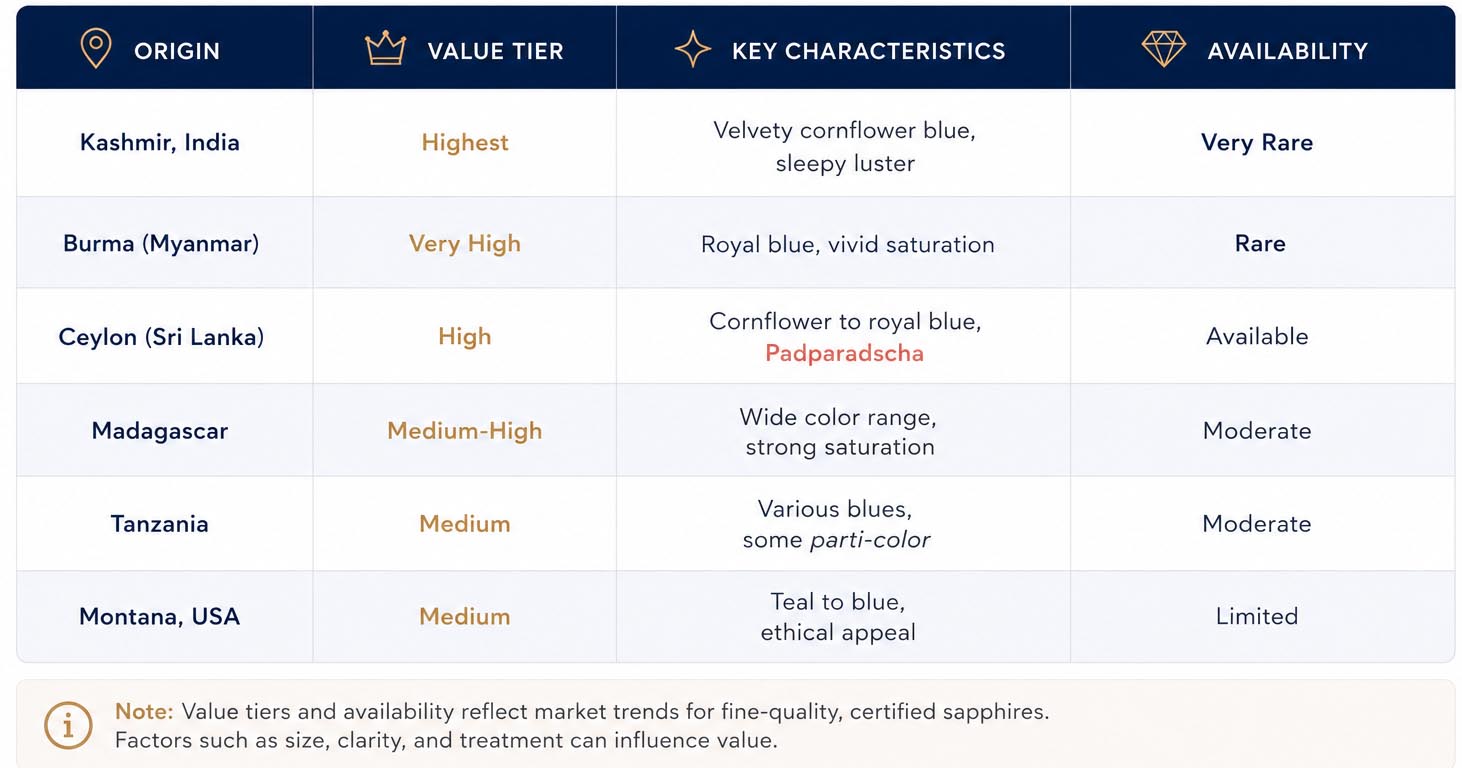
Kashmir, India: The Absolute Pinnacle of Sapphire Investment
Kashmir sapphires represent the gold standard of the sapphire investment world. Mined in the remote Zanskar Range of the Himalayan mountains at elevations above 15,000 feet, meaningful production from these legendary mines ceased by the early twentieth century. The geological conditions that created Kashmir sapphires, a brief period of metamorphic activity in the late Miocene epoch, will never be replicated. This makes Kashmir sapphires the only major gemstone origin where supply is not merely limited but permanently and absolutely fixed.
The characteristic color of fine Kashmir sapphires, described as velvety, sleepy cornflower blue, results from minute particles of calcium plagioclase that scatter light within the stone, creating a soft luminosity unlike any other sapphire origin. Between 2020 and 2025, Kashmir sapphires gained 40 to 70 percent in value, and the structural case for continued appreciation is as strong as it has ever been.
Burma (Myanmar): The Second Pillar of Premium Sapphire Investment
Burmese sapphires from the Mogok Valley represent the second tier of the premium investment market and have demonstrated exceptional price appreciation over the past two decades. Fine Mogok sapphires display a vivid royal blue color of exceptional saturation and brilliance, often described as electric or pigeon-blood adjacent, and command substantial premiums over equivalent stones from other origins. Supply from the Mogok Valley is severely constrained, with fine unheated examples becoming increasingly rare in the international market.
Ceylon (Sri Lanka): The Investor’s Most Accessible Premium Origin
Sri Lanka, known to the ancient world as Ceylon, has produced sapphires for over two thousand years and remains the single most important source of investment-grade sapphires accessible to the broad investor market. Ceylon sapphires encompass an extraordinary range of colors, from the characteristic cornflower blue and royal blue that have made Sri Lanka famous, to violet, yellow, orange, and the supremely rare Padparadscha, all within a single geological province in the island’s southwest.
For investment-grade Ceylon sapphires of five carats or above with GRS or GIA certification, prices frequently exceed USD 25,000 per carat. Unheated Ceylon stones with top cornflower blue color in the three to five carat range represent perhaps the best combination of investment quality, market accessibility, and price appreciation potential available to investors today. The island’s gem trading infrastructure, centuries of cutting expertise, and established international market recognition make Ceylon sapphires the most practical entry point for investors seeking a premium-origin, certified investment position.
Madagascar, Tanzania, and Emerging Origins
Madagascar emerged as a major sapphire source in the late 1990s and now produces a significant proportion of the world’s commercial and fine-quality sapphires. Madagascan sapphires can display strong, vivid colors comparable to Ceylon examples, and certified fine-quality specimens are increasingly accepted in the investment market, though they consistently trade at a discount to established origins. Tanzania’s Tunduru and Umba Valley deposits produce interesting color ranges, including parti-colored stones, but remain niche investment propositions compared to the classic origins.
Where to Buy Investment-Grade Sapphires at the Most Favorable Prices
The source of acquisition has a significant impact on the price paid for investment-grade sapphires. Understanding the distribution chain from mine to major auction house allows the informed investor to identify the most advantageous points of entry for maximum long-term value.
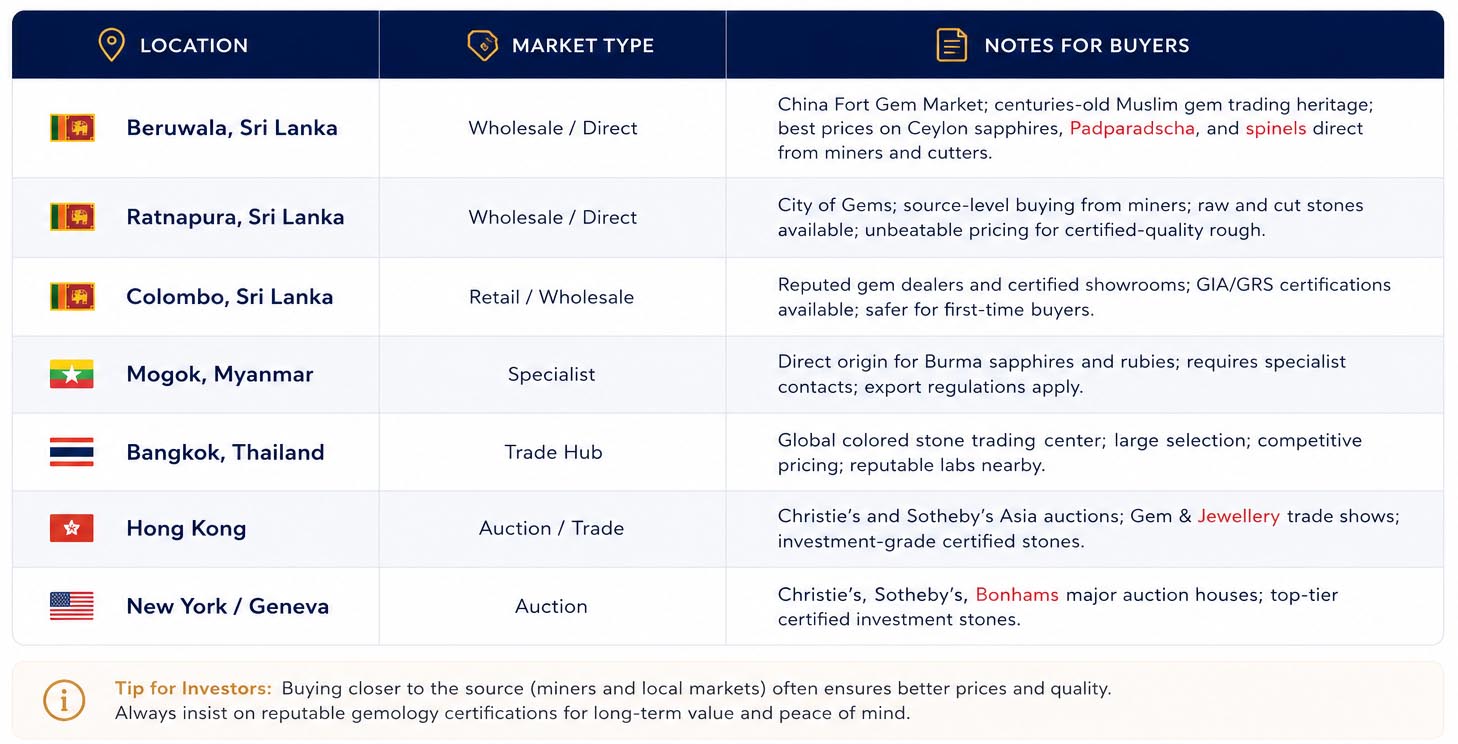
Beruwala, Sri Lanka: The Investor’s Gateway to Ceylon Sapphires
For investors specifically seeking Ceylon sapphires, Beruwala on Sri Lanka’s western coast represents one of the most extraordinary and accessible wholesale gem trading environments in the world. The China Fort area of Beruwala has been the heart of Sri Lanka’s gem trading industry for centuries, rooted in the trading heritage of the island’s Muslim merchant community who have been dealing in precious stones since the era of the ancient Moor seafarers.
The Beruwala gem market offers direct access to stones that have traveled the shortest possible path from mine to buyer. Investors who visit Beruwala with appropriate gemological knowledge, or who engage a reputable local agent, can purchase Ceylon sapphires, Padparadscha, spinels, alexandrites, cat’s eye chrysoberyls, and other native gemstones at prices that represent a substantial discount to those available in Western retail markets or at international auction. The breadth of available material, ranging from rough gemstone crystals to precision-cut investment stones, provides opportunities not available in any other single location outside Ratnapura itself.
It is essential to note that while Beruwala offers exceptional pricing, buyers should engage only with established dealers, request GIA or GRS certification for any stone intended as an investment, and exercise due diligence regarding treatment disclosure. The investment value of a stone purchased at Beruwala is dramatically enhanced by subsequently submitting it to a leading gemological laboratory for certification, transforming a wholesale purchase into a fully credentialed international investment asset.
Ratnapura: The City of Gems
Ratnapura, meaning City of Gems in Sinhalese, is the historical and operational center of Sri Lanka’s sapphire mining industry. Located in the Sabaragamuwa Province, Ratnapura sits at the center of the island’s gem-bearing gravel deposits and offers buyers the opportunity to purchase directly from miners and cutting workshops at source-level pricing. Visitors can observe the traditional illam mining process, inspect rough material before cutting, and commission cuts to their own specifications, providing a level of engagement with the production process unavailable anywhere else in the world.
How GIA Certification Transforms a Sapphire into a Financial Instrument
A sapphire without credible laboratory certification is a beautiful object. A sapphire with a GIA report is an investment asset with internationally recognized, independently verified specifications. The distinction is not merely semantic; it is the difference between a stone that can only be sold within a limited network of trusting buyers and one that can be offered at international auction to competitive bidders on six continents.
What the GIA Report Documents
The GIA Colored Stone Grading Report for a sapphire provides a comprehensive technical record of the stone’s physical and optical characteristics, including weight, dimensions, shape, cutting style, color description, clarity characteristics, and, most critically, the disclosure of any detected treatments. For sapphires from premium origins, the GIA may also issue an origin determination as part of the report, providing the critical provenance documentation that underpins origin premiums in the investment market.
- Treatment disclosure: The single most commercially important element; ‘no indications of heating’ is the foundation of investment-grade status
- Color description: Professional characterization of hue, tone, and saturation provides buyers with standardized, comparable color data
- Origin determination: Geographic provenance verified by GIA’s gemological analysis directly supports and quantifies the origin premium
- Clarity characteristics: Professional assessment of inclusions and their nature, distribution, and effect on the stone’s appearance
- Physical specifications: Precise weight and dimensional measurements provide the basis for replacement valuation and insurance
The Resale Premium of GIA Certification
In the secondary market, a sapphire without an internationally recognized certificate from GIA, SSEF, Gubelin, or GRS is viewed with significant skepticism by sophisticated buyers. Auction houses require certification for the inclusion of colored stones in their sales. Major dealers will either require their own laboratory submission before purchase or will offer substantially reduced prices for uncertified material, passing the certification cost and risk premium to the buyer.
The premium for GIA-certified sapphires over uncertified equivalents in the resale market consistently exceeds the cost of obtaining the certification, often by a multiple of ten or more for investment-grade specimens. Certification is therefore not a cost of ownership but an investment in the stone’s future liquidity and price realization. For investors, obtaining GIA certification is not optional; it is the non-negotiable foundation of a credible investment strategy.
Why ‘No Indications of Heating’ Is Worth Thousands Per Carat
The GIA treatment disclosure field, specifically the finding of no indications of heating, is the single line on a report that most dramatically affects a sapphire’s investment value. As noted earlier, approximately 95 percent of all commercial sapphires are heat-treated. The remaining five percent, those whose exceptional natural color and clarity render treatment unnecessary, are the stones that constitute the true investment market.
GIA gemologists determine treatment status through examination of the stone’s inclusion fingerprint under high magnification. Natural unheated sapphires typically contain intact rutile silk, unaltered crystal inclusions, and fluid inclusions with preserved two-phase characteristics. Heat treatment destroys these delicate internal features or transforms them into diagnostic markers of thermal alteration, providing definitive evidence of treatment to a trained gemologist. This scientific rigor is what gives the GIA’s no-heat determination its market authority and the investment premium it commands.
Market Reality
A GIA-certified, unheated Ceylon sapphire of five carats and fine royal blue color will consistently command two to three times the auction price of an equivalent heated stone. On a five-carat stone trading at USD 20,000 per carat unheated, the heating premium represents USD 70,000 to USD 130,000 in absolute value. This is the single most powerful value lever available to the sapphire investor.
Sapphires and Generational Wealth: An Asset That Outlasts Markets
The concept of generational wealth, the deliberate accumulation and transfer of assets across multiple generations of a family, has been practiced by the world’s most affluent and historically resilient families for centuries. Among the assets most consistently represented in the holdings of old-money families, royal collections, and ancient institutional treasuries, colored gemstones and sapphires in particular occupy a position of singular importance.
The Multi-Generational Value Proposition
Consider the value trajectory of a fine, unheated Kashmir sapphire purchased in 1980 for approximately USD 5,000 per carat. That same stone, with its GIA certification confirming Kashmir origin and no heat treatment, would today command between USD 100,000 and USD 250,000 per carat at international auction, representing a twenty to fifty-fold increase in value over forty-five years. More importantly, it has survived every recession, financial crisis, currency devaluation, geopolitical disruption, and market crash that has occurred during that period, emerging from each with its intrinsic value not merely intact but enhanced.
This multi-generational value proposition is not unique to Kashmir sapphires. Ceylon sapphires purchased by a knowledgeable investor at source prices in Beruwala or Ratnapura today, certified by GIA and held for twenty to thirty years, will in all probability represent extraordinary value appreciation relative to most conventional asset classes, while simultaneously representing a beautiful, meaningful, and portable family heirloom.
Inheritance, Transfer, and Estate Planning Advantages
Certified gemstones offer practical advantages in estate planning and wealth transfer that are not available with most other asset classes. A sapphire held in a safe deposit box or specialized secure storage can be transferred between generations with relative simplicity, incurring no management fees, no custodial charges, and, in many jurisdictions, favorable tax treatment compared to the forced liquidation of securities or real estate.
Families who have maintained collections of certified investment-grade sapphires across multiple generations have consistently found that each successive generation inherits not merely a financial asset but a tangible connection to family history, a story of prudent stewardship, and an asset that continues to appreciate in their custody. This combination of financial performance and emotional resonance is unique to fine gemstones among the alternative asset classes.
The Role of Documentation in Multi-Generational Preservation
For a sapphire to function as a true generational wealth vehicle, documentation must be maintained alongside the stone through every transfer and ownership change. This includes the original laboratory certificate, insurance appraisals updated every three to five years, purchase documentation, and provenance records of any significant previous ownership. For stones that pass through auction, the auction catalog entry becomes part of the provenance record, often adding value in subsequent sales. The investor who maintains meticulous records creates not merely a financial asset but a documented legacy with its own appreciating history.
The Value Formula: What Makes a Sapphire More Valuable Than Another
The valuation of investment-grade sapphires is a complex, multi-variable assessment that requires genuine gemological expertise. The following factors interact with each other to determine the total premium a stone will command in the international market.
1. The Rarity Multiplier
Every positive value characteristic a sapphire possesses compounds with every other positive characteristic. A stone that is unheated is rare. A stone that is unheated and from Kashmir is extremely rare. A stone that is unheated, from Kashmir, over five carats, eye-clean, and of ideal cornflower blue color is so extraordinarily rare that it exists in a category of its own, and its price reflects not a linear combination of individual premiums but an exponential rarity multiplier. Understanding this compounding of rarity is essential to understanding why the finest sapphires command prices that seem impossible to those unfamiliar with the market.
2. Color Purity and Consistency
The purity of the blue in a sapphire, meaning the absence of modifying hues such as gray, green, or purple, dramatically affects value. A stone with a pure, clean blue of ideal saturation, without any gray component that reduces its perceived brightness, commands a premium over an equivalent stone with a muddied or secondary-toned color. Color should also be consistent throughout the stone’s face-up appearance, without significant darkening near the girdle or obvious color concentration in specific zones.
3. Origin Premium Compounding
The combination of a prestigious origin with ideal quality characteristics creates a value that exceeds the sum of its parts. A fine Kashmir sapphire is worth more than its color, clarity, and treatment status alone would suggest because the origin itself carries a historical, cultural, and investment narrative that activates a specific subset of the most motivated and financially capable buyers in the world. This narrative premium is not irrational; it reflects the genuine, permanent geological impossibility of producing new Kashmir sapphires, making every existing fine example an increasingly irreplaceable asset.
4. Size Exponential
The relationship between carat weight and per-carat price in the investment sapphire market is exponential, not linear. For each meaningful size threshold crossed, the per-carat price increases at an accelerating rate, because the number of potential buyers willing and able to pay for the stone narrows as the total price increases, while the rarity of the stone simultaneously increases with size. A ten-carat, fine, unheated Ceylon sapphire does not cost ten times a one-carat equivalent; it costs fifty to one hundred times as much in total, because stones of that size and quality are encountered perhaps once or twice in a generation.
5. The Certification Premium
As discussed at length earlier in this article, the GIA certificate is not merely documentation but a value-creating instrument in its own right. The combination of no-heat certification, origin determination, and detailed quality disclosure from the world’s most respected gemological institution places a stone in a different commercial category entirely from uncertified equivalents, accessing a global buyer pool willing to pay substantial premiums for the certainty and liquidity that certification provides.
Conclusion: Building a Sapphire Investment Strategy
The case for sapphires as investment assets has never been more compelling. Twenty years of consistent price appreciation from established origins, the structural impossibility of meaningful supply increases for the finest material, the expanding global buyer base driven by Asian wealth creation, and the growing infrastructure of certification and market transparency all point in the same direction: investment-grade, certified sapphires from premium origins represent an exceptional long-term store of value with genuine appreciation potential.
The investor approaching this market for the first time should prioritize three principles above all others. First, buy quality rather than quantity; a single exceptional stone from a premium origin with GIA certification will outperform a collection of mediocre stones of equivalent total investment. Second, insist on certification and treatment documentation before any purchase intended for investment; a beautiful sapphire without a current GIA report is a jewelry purchase, not an investment asset. Third, consider the source of acquisition carefully; buying at or near source level in established markets such as Beruwala or Ratnapura in Sri Lanka, or through specialist dealers with direct supply relationships in Bangkok or Colombo, can provide meaningful pricing advantages over retail or auction acquisition for buyers with appropriate gemological knowledge or trusted professional guidance.
Sapphires have survived the rise and fall of empires, the collapse of currencies, and the disruption of every financial system that has existed since their first mining two thousand years ago. They will continue to hold and grow their value through whatever economic turbulence the next twenty years may bring, as they have through the last twenty. For investors seeking a tangible, portable, beautiful, and historically proven store of value that can be enjoyed in the present and passed on across generations, there are few assets on earth more worthy of serious consideration.
Disclaimer
This article is prepared for educational and informational purposes by a qualified gemologist and market analyst. It does not constitute financial or investment advice. Gemstone markets, like all investment markets, carry inherent risks, and past price performance is not a guarantee of future results. Prospective investors should conduct independent due diligence and consult qualified financial and gemological professionals before making any investment decisions. All price data cited reflects historical and current market observations from reputable industry sources and auction records.