
What Determines the Price of a Gemstone? A Simple Guide for Beginners
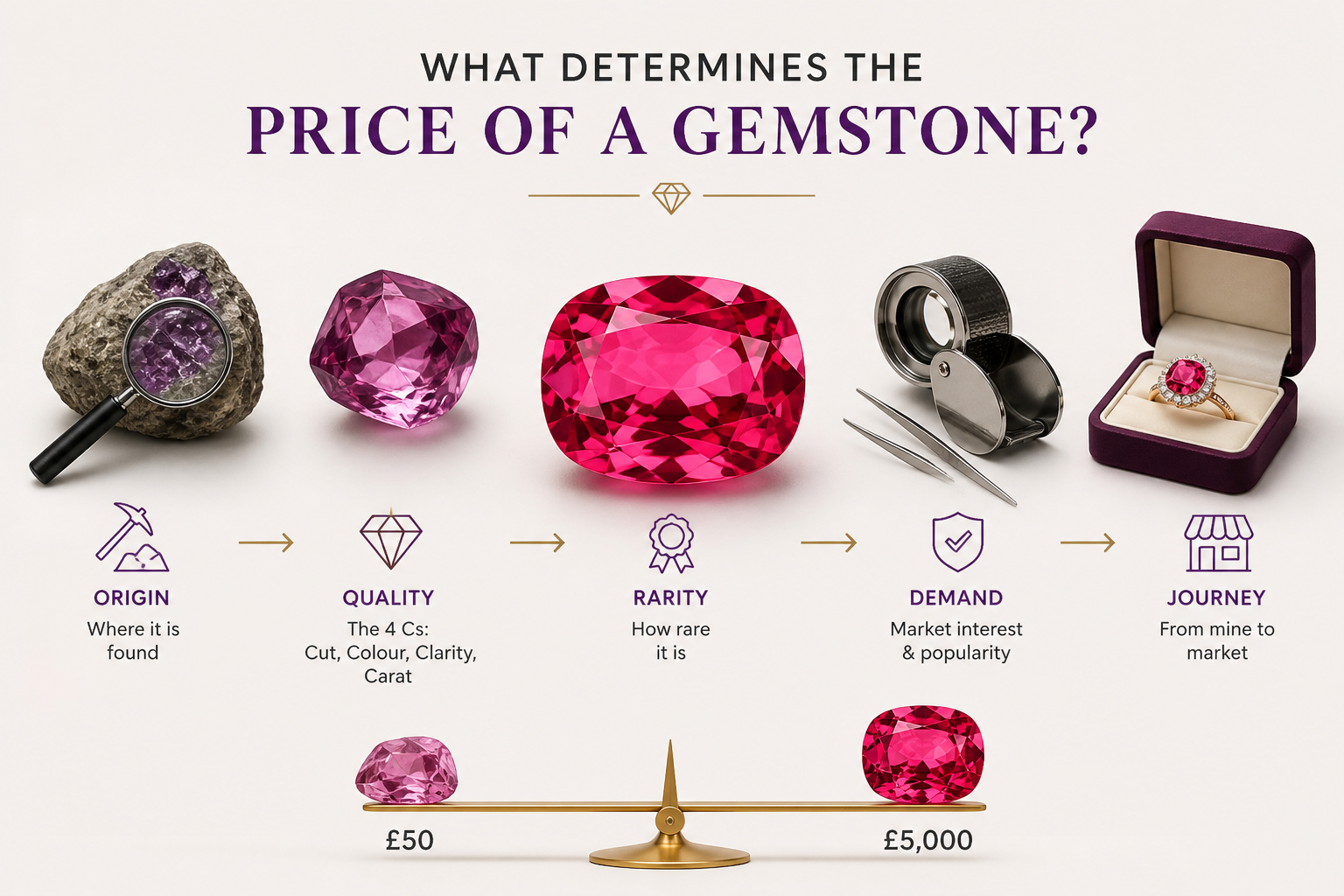
If you have ever looked at two gemstones and wondered why one costs £50 and another costs £5,000, you are not alone. The price of a gemstone is not random. It is built step by step, from the moment it is discovered in the earth to the moment it reaches a jewellery shop.
Understanding how gemstone pricing works can help you avoid overpaying and make smarter buying decisions. In this guide, you will learn exactly where gemstone value comes from in simple, practical terms.
Where Do Gemstones Come From?
Before talking about price, you need to understand the origin.
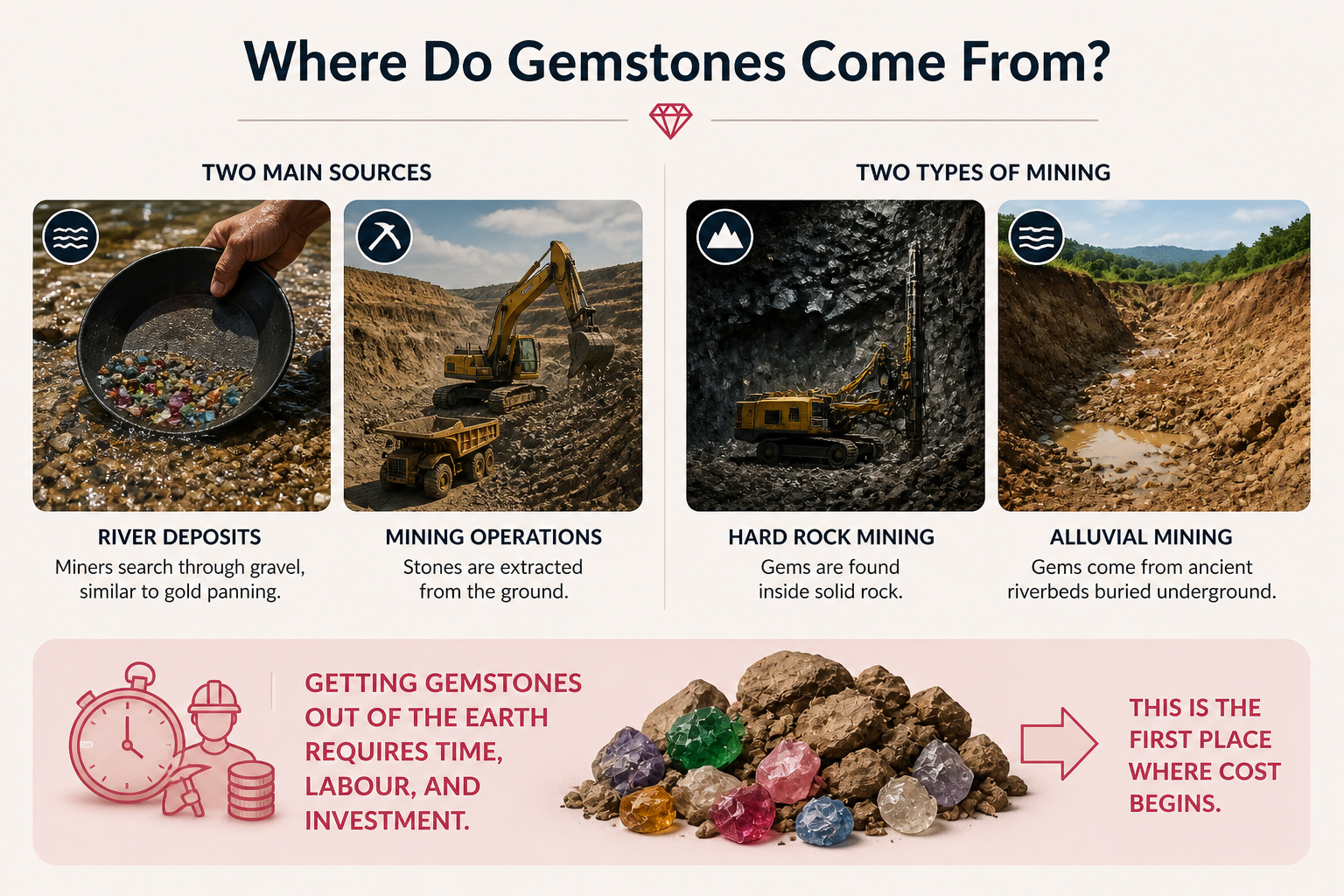
Most gemstones come from two main sources:
- River deposits where miners search through gravel, similar to gold panning
- Mining operations where stones are extracted from the ground
There are also two types of mining:
- Hard rock mining where gems are found inside solid rock
- Alluvial mining where gems come from ancient riverbeds buried underground
No matter the method, one thing is always true:
Getting gemstones out of the earth requires time, labour, and investment. This is the first place where cost begins.
Stage 1: Mining Costs
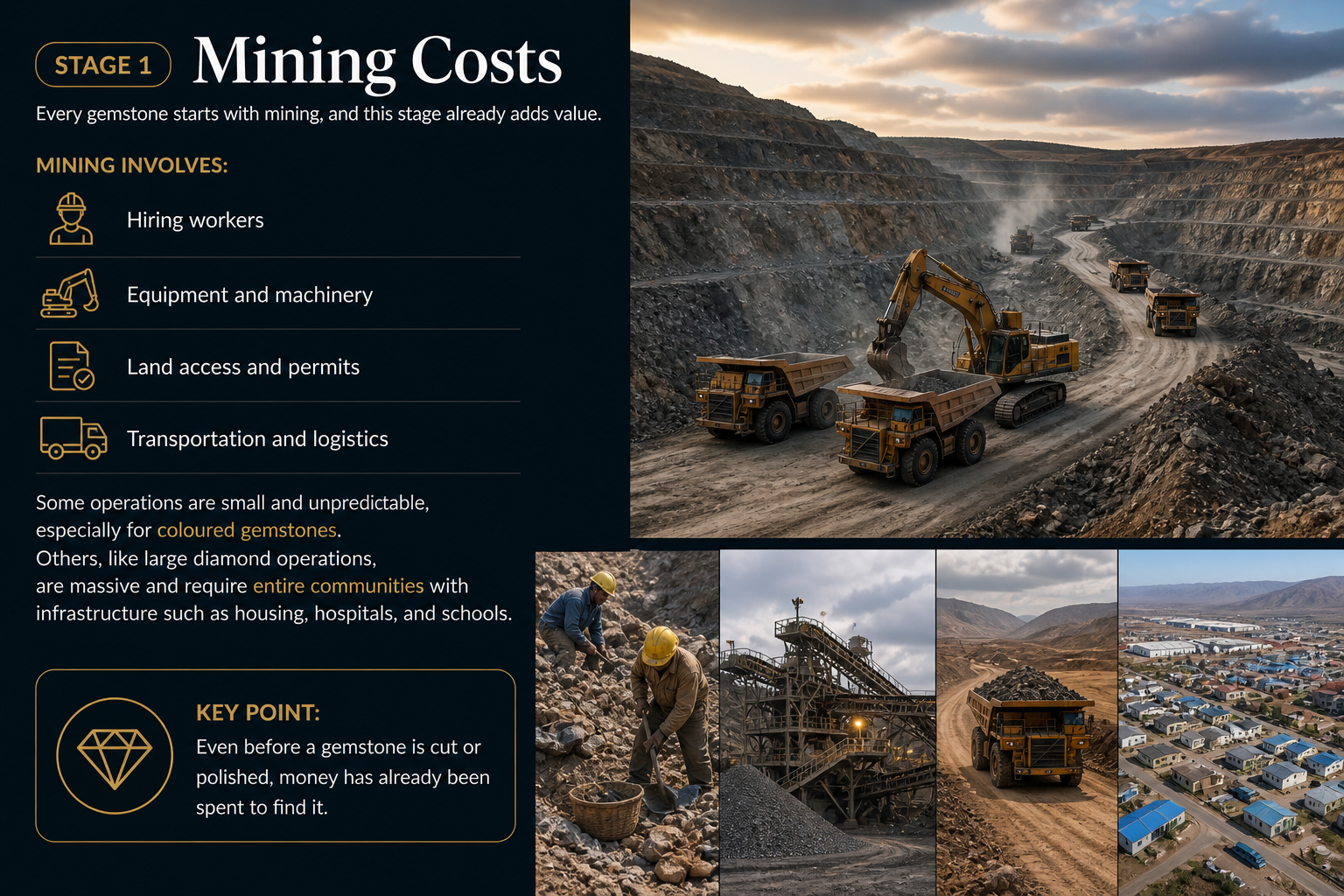
Every gemstone starts with mining, and this stage already adds value.
Mining involves:
- Hiring workers
- Equipment and machinery
- Land access and permits
- Transportation and logistics
Some operations are small and unpredictable, especially for coloured gemstones. Others, like large diamond operations, are massive and require entire communities with infrastructure such as housing, hospitals, and schools.
Key point:
Even before a gemstone is cut or polished, money has already been spent to find it.
Stage 2: The Value of Rough Gemstones
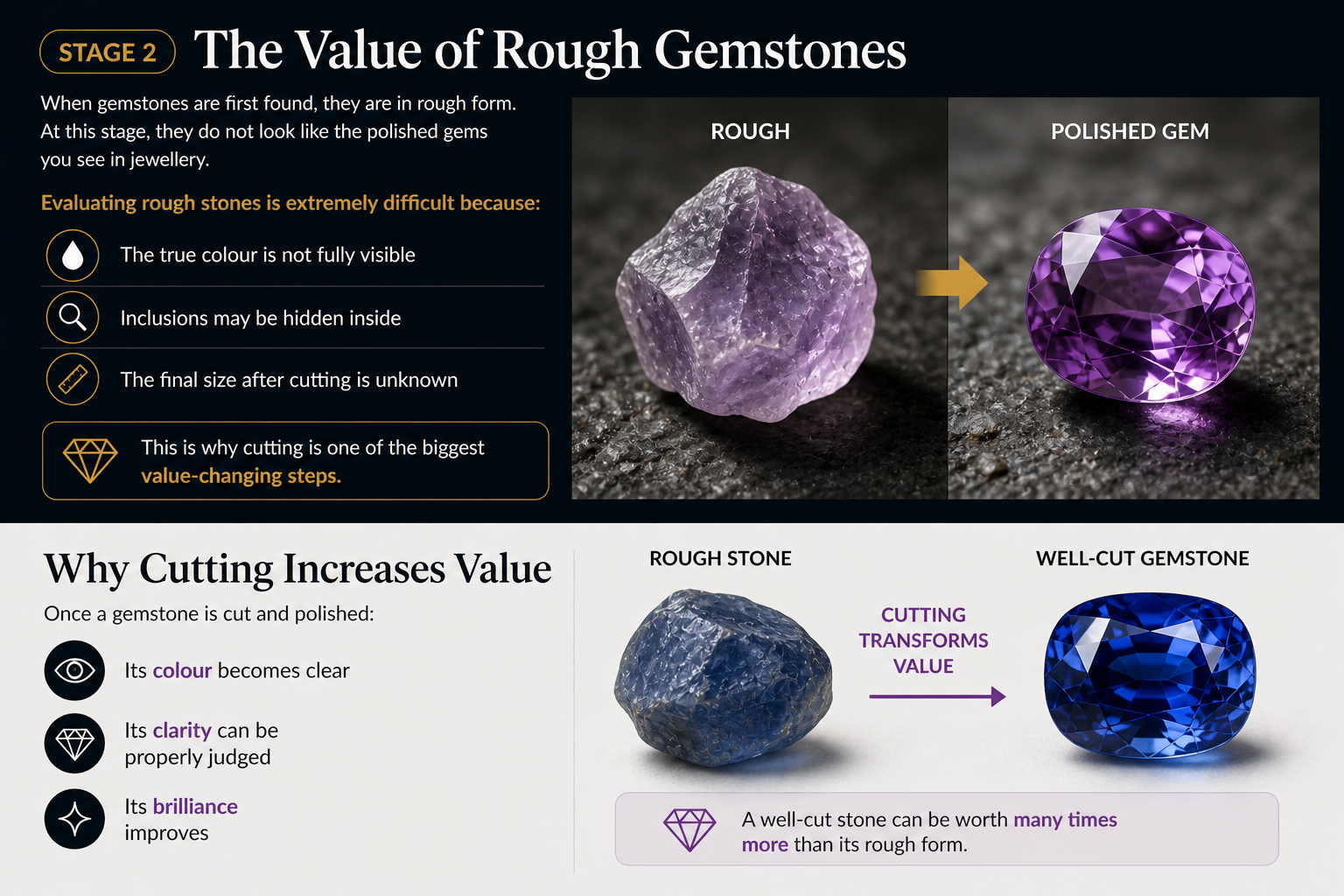
When gemstones are first found, they are in rough form. At this stage, they do not look like the polished gems you see in jewellery.
Evaluating rough stones is extremely difficult because:
- The true colour is not fully visible
- Inclusions may be hidden inside
- The final size after cutting is unknown
This is why cutting is one of the biggest value-changing steps.
Why Cutting Increases Value
Once a gemstone is cut and polished:
- Its colour becomes clear
- Its clarity can be properly judged
- Its brilliance improves
A well-cut stone can be worth many times more than its rough form.
Stage 3: Rarity Drives Price
Rarity is one of the most powerful factors in gemstone pricing.
A gemstone becomes valuable when it is:
- Hard to find
- Available in limited supply
- Not seen in the market for a long time
For example:
- A common gemstone like amethyst is widely available, so prices remain low
- A rare gemstone with unique colour or size can command very high prices
Why Rarity Matters
Even if a gemstone is beautiful, it does not mean it is expensive.
- Beautiful but common = affordable
- Beautiful and rare = expensive
Sometimes new deposits are discovered, which can suddenly increase supply and reduce prices. Other times, a rare colour appears after many years, and demand rises sharply.
Stage 4: Wholesale Market Pricing
After cutting, gemstones enter the wholesale market.
This is where:
- Dealers and traders from different countries buy and sell stones
- Prices are negotiated based on quality and demand
- Competition can increase value
At this stage, professionals evaluate gemstones based on:
- Colour
- Clarity
- Size (carat weight)
- Rarity
Experienced buyers can quickly identify whether a stone is:
- Common and widely available
- Rare and highly desirable
This is where knowledge becomes critical. Without experience, it is very difficult to judge whether a price is fair.
Stage 5: Retail Pricing
The final stage is the retail market, where gemstones are sold to customers.
Retail pricing includes:
- Shop overhead costs
- Import taxes and duties
- Marketing and branding
- Profit margins
This is why gemstones are more expensive in jewellery shops compared to wholesale markets.
Important Insight
Retail price is not just extra cost. It also gives you:
- Access to verified stones
- Convenience and availability
- Ability to resell within your local market
For example, in regions like Europe, import taxes can increase gemstone prices. Once the stone is already in the country, resale value often reflects that higher retail level.
The 4 Main Factors That Determine Gemstone Price
To simplify everything, gemstone pricing comes down to four key stages:
- Mining Cost
The effort and expense required to extract the stone - Rarity
How uncommon the gemstone is in terms of colour, size, and availability - Wholesale Market Demand
How much buyers are willing to pay in trading markets - Retail Markup
The final price added when selling to customers
Why Experience Matters in Pricing
One of the most important lessons in gemstones is this:
Price is not just about the stone. It is about knowledge.
Experienced buyers:
- Recognise rare colours quickly
- Understand market trends
- Negotiate better prices
- Build relationships with dealers
Beginners often struggle because:
- They rely only on appearance
- They do not know market value
- They may overpay for average stones
How Buyers Get Better Prices
If you want to buy gemstones at better prices, consider these strategies:
- Buy in larger quantities when possible
- Build relationships with trusted sellers
- Learn to evaluate quality yourself
- Avoid emotional buying without comparison
Dealers are more flexible with pricing when:
- You are a repeat customer
- You buy multiple stones
- You understand the market
The price of a gemstone is not decided in one moment. It is built through a journey:
From the earth → to cutting → to trading → to retail
Each step adds cost, risk, and value.
If you understand this process, you gain a strong advantage. You can:
- Spot overpriced stones
- Identify real value
- Make confident buying decisions
Next time you see a gemstone, do not just look at its beauty. Think about its journey. That is where its true value comes from.