
Is Tsavorite Garnet Better Than Emerald?
There is a green stone quietly stealing the spotlight from one of the most celebrated gems in history. It carries the fire of a fine sapphire, the lush color of a forest at dawn, and a clarity that most emeralds simply cannot match. It is tsavorite garnet, and if you have never seriously considered it for your next jewelry purchase, this article is your invitation to look again.
For centuries, green gems have held a singular power over human imagination. Our eyes are biologically tuned to detect green with extraordinary precision, more so than almost any other color. Green signaled food, water, and life to our ancestors. It is no surprise that green gemstones have commanded fortunes, decorated crowns, and been traded across continents since antiquity. But not every green stone that carried the name “emerald” throughout history would qualify as one today. Modern gemology has given us the tools to separate the pretenders from the true article, and in doing so, it has helped tsavorite garnet find its rightful place in the conversation.
What Exactly Is Tsavorite Garnet?
Tsavorite belongs to the grossular branch of the garnet family. Garnet is often thought of as simply a red stone, but the family is far more complex than that. There are two major branches: the pyrospite group, which contains familiar names like spessartine and pyrope, and the ugrandite group, which includes demantoid and grossular. Within grossular, colors can range from colorless to orange to the vivid green of tsavorite.
Unlike spessartine, which is idiochromatic and always carries some version of orange or reddish-brown, grossular garnet is allochromatic. Its color comes from trace elements introduced during formation rather than from its fundamental chemical structure. In the case of tsavorite, vanadium and chromium are responsible for that deep, saturated green. This distinction matters because it means grossular garnet can exist across a wide color range, though the gem-quality green stones are what have captured the market and the imagination of collectors worldwide.
“When my clients come to me asking for an emerald, I ask them if their heart is set on emerald or if their heart is set on a natural green stone. Because if it is a natural green stone, why not consider this?”Peter Nelson, Gemologist
The Story Behind the Name
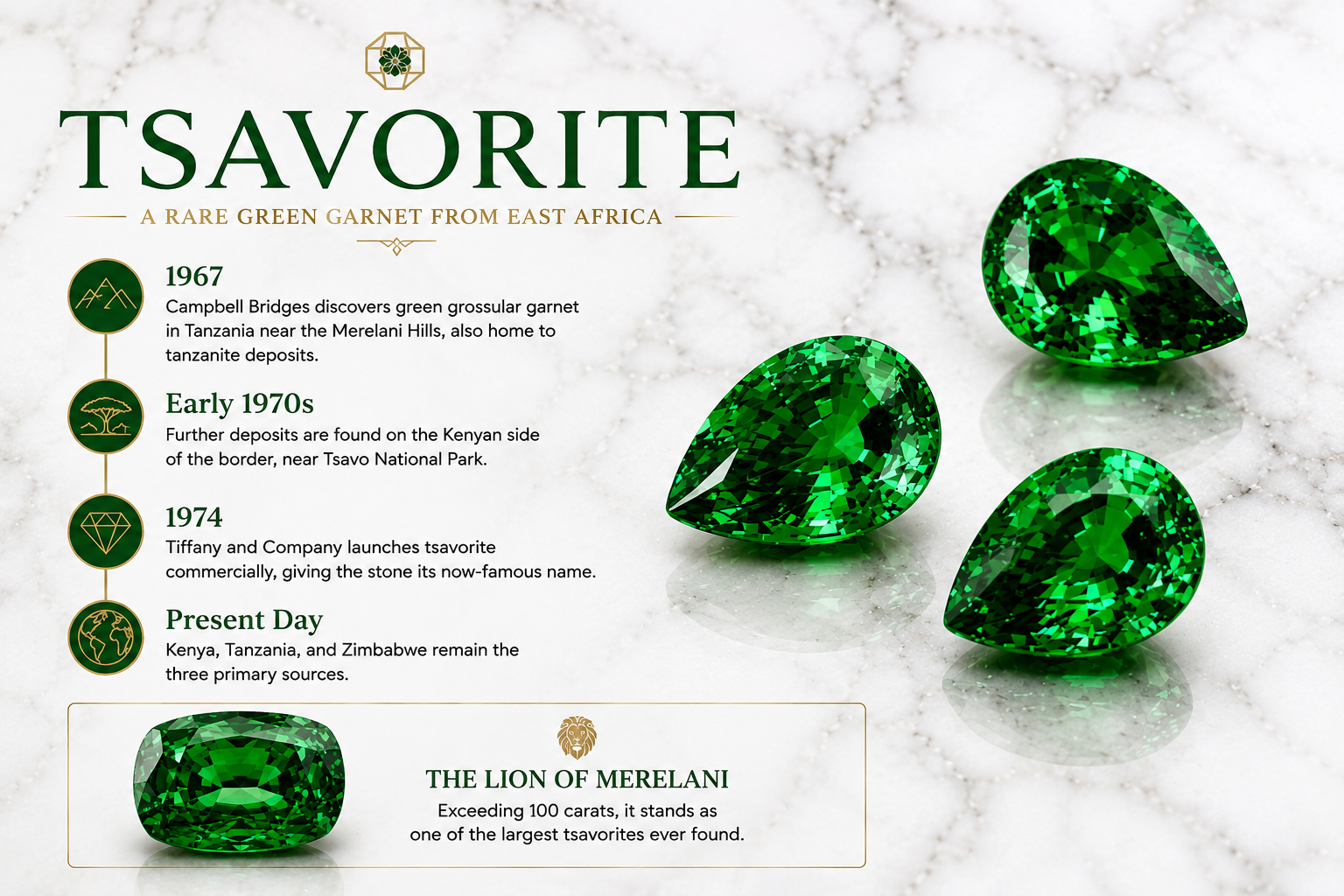
Tsavorite was first discovered in Zimbabwe, but the name itself honors the Tsavo National Park in Kenya, one of Africa’s most iconic wildlife reserves. The naming was a collaboration between Campbell Bridges, the geologist credited with the gem’s discovery, and the leadership of Tiffany and Company. The involvement of Tiffany was no accident. From the very beginning, this was a stone being positioned for the fine jewelry market.
There is something fitting about the way powerful patrons have always shaped gemstone history. Morganite carries the name of banker J.P. Morgan. Tanzanite was named and championed by Tiffany in 1968. And now tsavorite carries the spirit of the East African savanna in its name and in its color. These stones do not just come from the earth. They come with stories.
How Tsavorite Performs Under Gemological Testing
Understanding a stone’s optical and physical properties is what separates informed buyers from those who rely on faith alone. Tsavorite has a gemological profile that genuinely impresses across several key measurements.
Singly Refractive
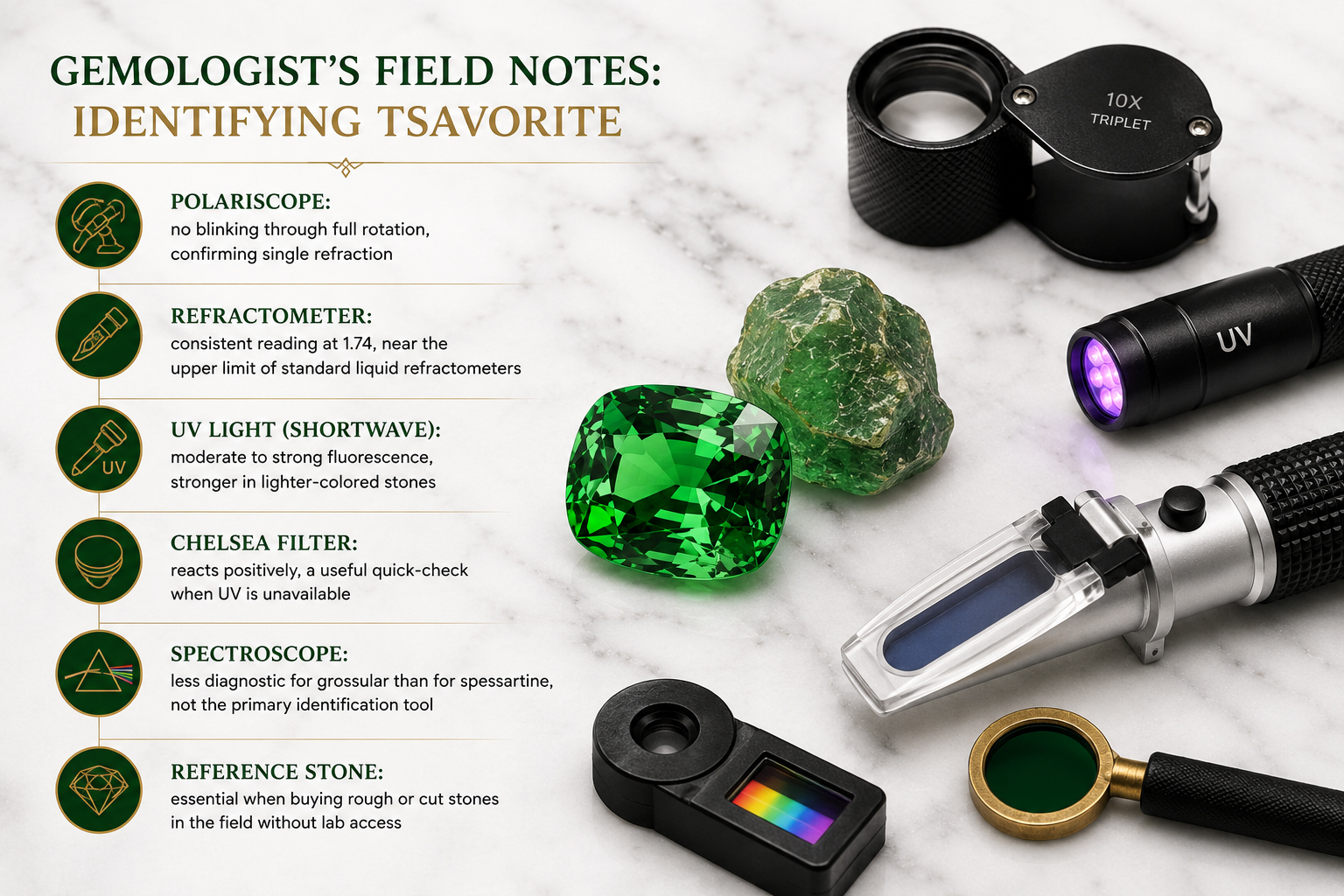
Unlike emerald, which is doubly refractive and splits light into two separate rays, tsavorite is singly refractive. Under a polariscope, it shows no blinking as the stone is rotated through its full 360 degrees. This single refraction is a reliable early identifier and rules out beryl, tourmaline, and several other common green stones in one quick step.
Refractive Index of 1.74
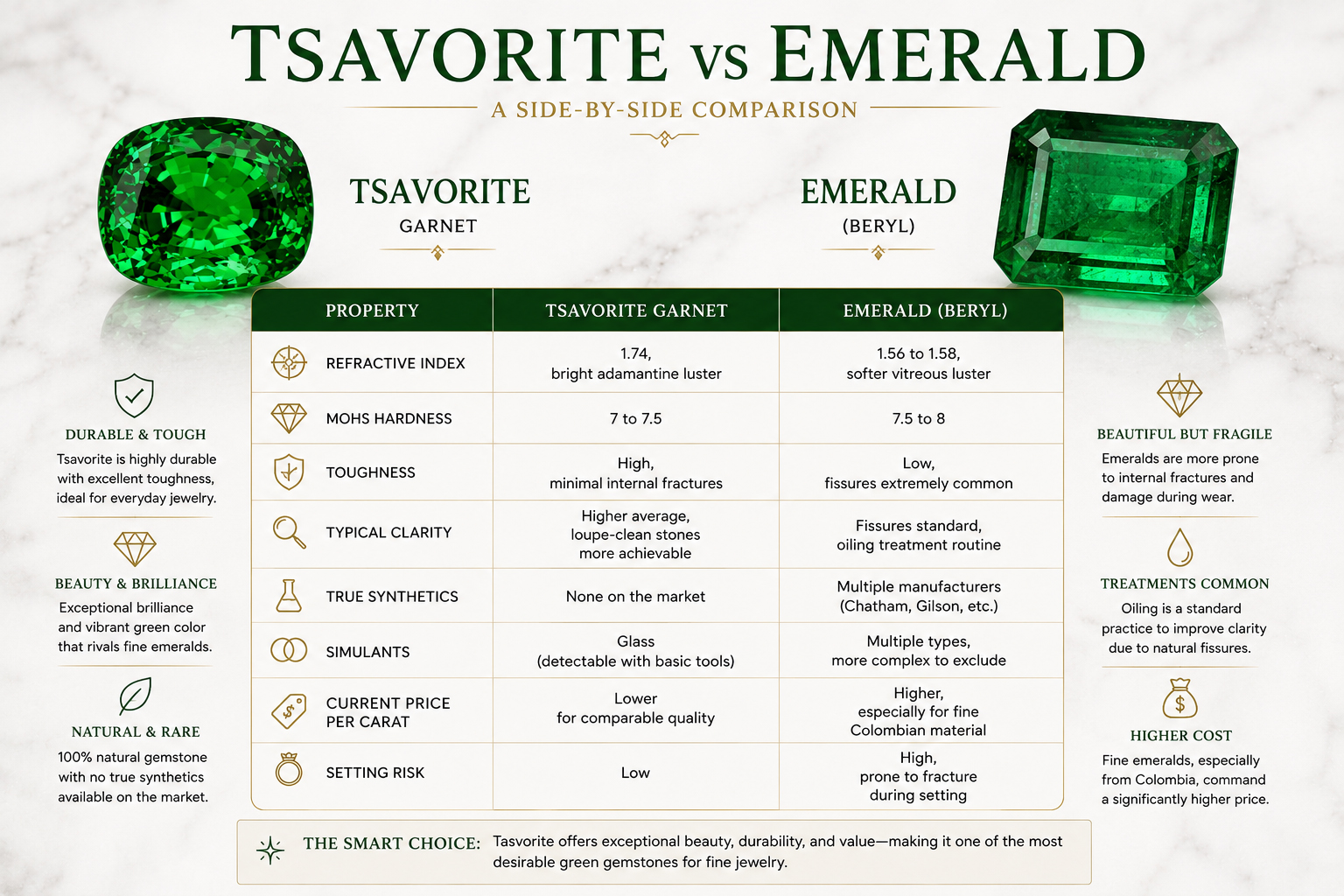
The refractive index measures how strongly a stone bends light, and it has a direct bearing on luster. Tsavorite sits at a consistent 1.74, which is remarkably high. For context, corundum, the mineral family that includes rubies and sapphires, reads between 1.76 and 1.77. Emerald reads between 1.56 and 1.58. That difference of nearly 0.17 is not trivial. Where emerald shows a somewhat subdued, glassy luster, tsavorite delivers a bright, lively sparkle that punches well above its weight in jewelry.
Shortwave UV Fluorescence
One characteristic that sets tsavorite apart from most garnets is its fluorescence under shortwave UV light. Most stones in the pyrospite family do not fluoresce, but tsavorite does, making UV testing a genuinely useful identification tool. Interestingly, more intensely colored stones in the same parcel tend to fluoresce less than lighter specimens. This fluorescence also serves as a practical defense against fakes. A faceted piece of glass, which shares tsavorite’s singly refractive nature, is extremely unlikely to show the same UV response.
Tsavorite vs Emerald: A Direct Comparison
This is the question most buyers eventually ask, and the honest answer depends on what you value most. For anyone who wants a green gemstone that performs beautifully in jewelry, holds its character over time, and presents fewer risks during the setting process, the comparison tilts strongly toward tsavorite. Here is how the two stones stack up across the criteria that actually matter at the point of purchase and beyond.
The Real-World Case for Tsavorite in Jewelry
One of the most overlooked considerations when purchasing a colored gemstone is what happens after the sale. A stone does not live in a display case. It gets worn, knocked against surfaces, exposed to chemicals in hand creams and cleaning products, and handled repeatedly by a jeweler every time a setting needs repair or resizing. Toughness, which is distinct from hardness, governs how a stone resists chipping and fracturing under mechanical stress. And this is where tsavorite has a decisive advantage.
Emerald has a well-documented reputation for being fragile. Most natural emeralds contain internal fractures and fissures, and it is considered standard trade practice to treat them with cedarwood oil or resin to improve apparent clarity. These treatments can degrade over time, need to be disclosed, and change the calculus of value. For a stone that already carries a significant price, the combination of brittleness and treatment dependence introduces risk that buyers do not always fully appreciate in the moment.
“If the setter goes and breaks my 1 carat or 5 carat emerald, even if I recut those two pieces, it is not worth anywhere near the same amount as that one emerald was whole.”Peter Nelson, Gemologist
Tsavorite is a far more resilient stone in practical use. Eye-clean specimens, while still rare and priced accordingly, occur with far greater frequency than they do in emerald. The crystal structure of grossular garnet simply does not carry the same predisposition toward fracture, which means a setter can work with tsavorite more confidently, and a wearer can enjoy it with considerably less anxiety about long-term preservation.
The Authenticity Advantage
Part of tsavorite’s value proposition is the simplicity of its authenticity. There are no laboratory-grown tsavorites that test identically to natural stones under standard gemological instruments. There are simulants, most commonly glass, but glass is straightforward to eliminate through refractometer readings and UV response. Compare this to emerald, where synthetic versions from multiple manufacturers have been on the market for decades and require sophisticated laboratory analysis to distinguish from natural material.
For private buyers, estate sales, or transactions where third-party laboratory certification is not readily available, the ability to confidently identify a stone with basic tools is genuinely valuable. Once you have established that a stone is grossular garnet with the appropriate optical properties, your identification work is largely complete. The stone is what it presents itself to be.
When Emerald Still Wins
This is not a case against emerald in every circumstance. Emerald holds a place in gem history, culture, and human desire that no other stone occupies. Colombian emeralds of fine quality have a color character, a warmth, and a depth that no other stone in the world fully replicates. There are specific hues within the emerald range, particularly the blue-green or deeply saturated medium green of top Colombian and Zambian material, that tsavorite does not duplicate. If a client specifically wants that color, or if they want emerald because of its historical weight and symbolic resonance, tsavorite is a different stone rather than a replacement.
The honest framing is this: are you buying green, or are you buying emerald? If the answer is green, tsavorite deserves serious consideration on its own terms. If the answer is emerald specifically, then the premium, the risk, and the irreplaceable beauty of fine emerald are all part of what you are choosing to purchase.
The Price Trajectory Worth Watching
At present, quality tsavorite commands significantly lower prices per carat than comparable emerald. Fine material above two carats with excellent color and minimal inclusions already trades at serious premiums within the trade, but the gap between tsavorite and top emerald pricing remains wide. That gap is expected to narrow. Mining output from the Merelani Hills and the Tsavo border region is constrained, supply is not growing in proportion with rising demand, and international awareness of the stone continues to build steadily among collectors and fine jewelry buyers.
This is a stone worth knowing now, before the price discovery that lies ahead.