
Sinhalite: Sri Lanka’s Best-Kept Gemological Secret
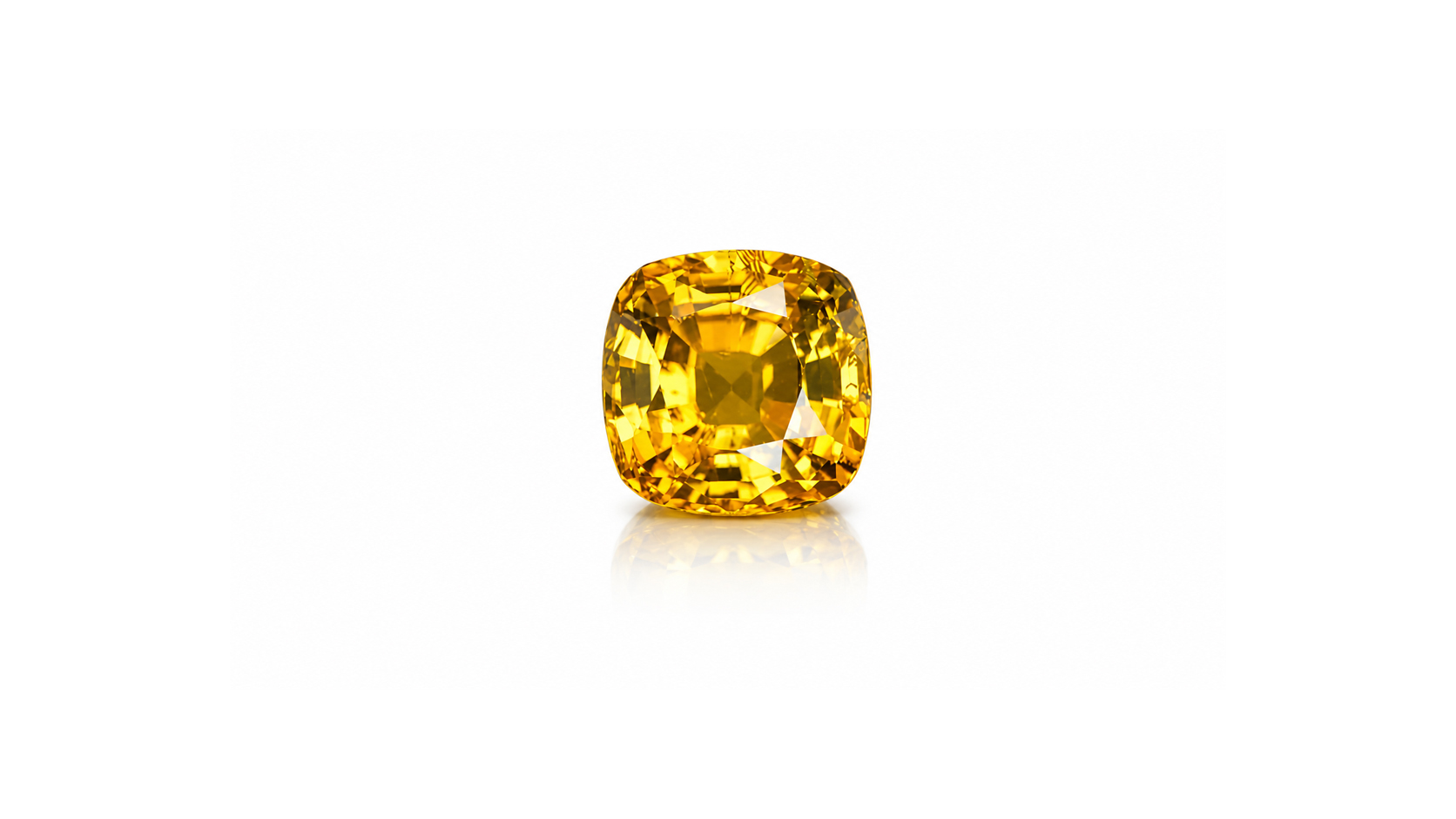
There are gemstones that sit in display cases at every jeweler in the world, and then there are gemstones that most jewelers have never held in their hands. Sinhalite belongs firmly to the second category. Rich in honey and amber tones, geologically fascinating, and carrying the name of an ancient civilization, sinhalite is the kind of stone that once you encounter it, you do not easily forget it.
As a gemologist, I find sinhalite particularly compelling not just for its beauty but for its story. A stone that was hiding in plain sight for decades, passed off as peridot by trained professionals, until Swiss gemologist Dr. E. Gubelin finally set the record straight in 1952. That kind of history adds a layer of depth that no amount of marketing can manufacture.
Whether you are a collector, a jewelry designer, or simply someone curious about the rarer corners of the gem world, this guide covers everything you need to know about sinhalite, from its geological origins to its current market value.
The Discovery and History of Sinhalite
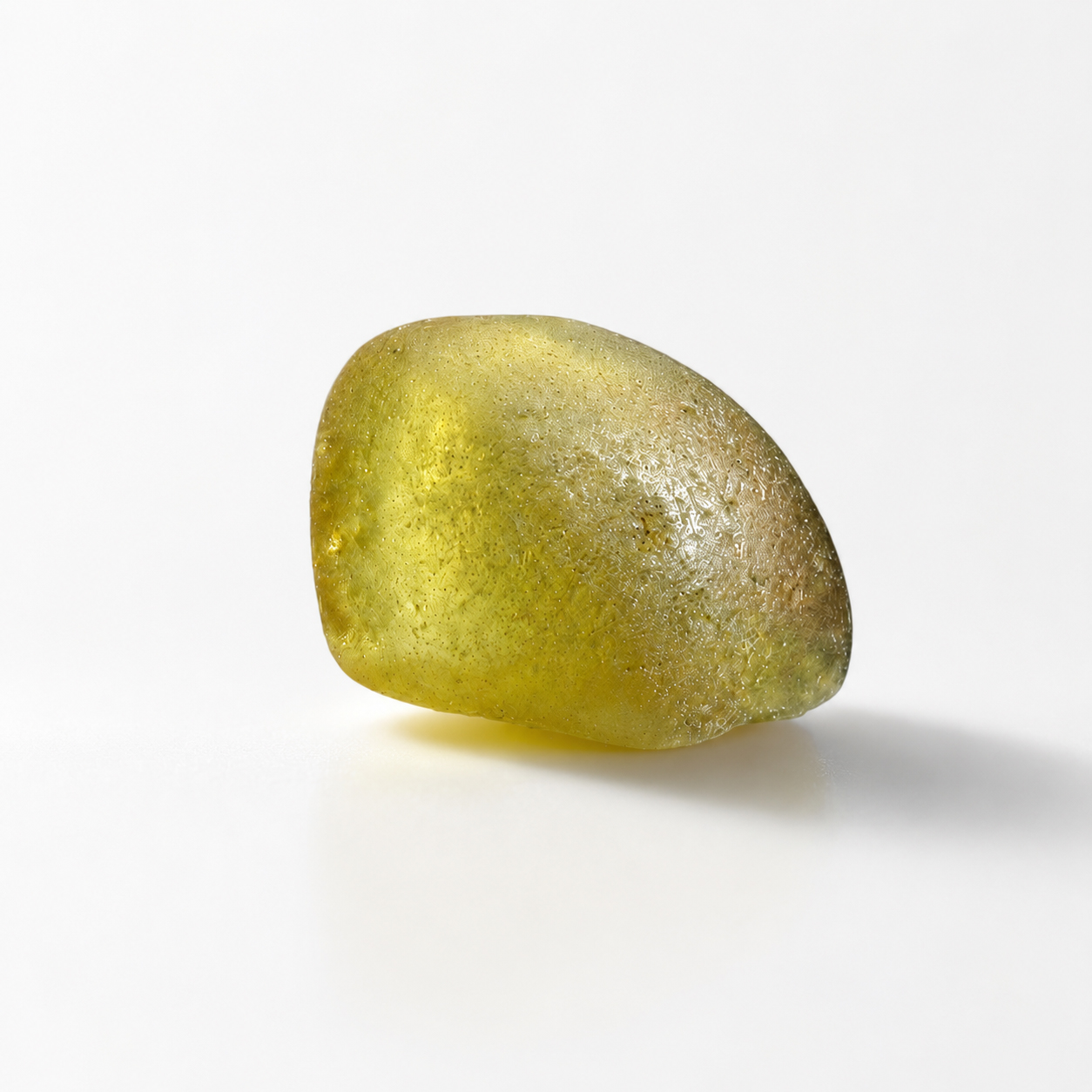
For a gemstone with such a fascinating identity, sinhalite spent a surprisingly long time being mistaken for something else entirely. For much of the early and mid twentieth century, specimens of sinhalite were catalogued and sold as brownish yellow peridot. The colors are similar, the refractive indices are close enough to fool a casual examination, and without modern analytical tools, distinguishing the two was genuinely difficult.
That all changed in 1952 when Dr. E. Gubelin, a Swiss gemologist whose contributions to the field are hard to overstate, conducted a rigorous mineralogical study on stones that had long been assumed to be peridot. His findings were clear: these were not peridot at all. They were a chemically distinct mineral species that had never been formally described before.
“Sinhalite was hiding in gem collections around the world for decades. What Dr. Gubelin uncovered in 1952 was not just a new mineral, it was a correction of history.”
GIA Graduate Gemologist Perspective
The new mineral was named sinhalite after Sinhala, the Sanskrit and ancient term for Sri Lanka. It was an appropriate tribute. The island had been producing these stones for generations without anyone realizing exactly what they were. The naming also cemented the connection between sinhalite and the incredibly rich gemological heritage of Sri Lanka, a country that has gifted the world with blue sapphires, alexandrite, cat’s eye chrysoberyl, and so much more
Formation and Geology: Why Sinhalite Is So Rare
Understanding why sinhalite is rare requires a brief trip underground. This gem does not form under ordinary geological circumstances. Sinhalite develops in high temperature, high pressure environments deep within the Earth’s crust, most commonly in two specific geological settings: pegmatites and contact metamorphic zones.
Pegmatites are igneous rocks that cool very slowly, allowing large crystals to grow over long periods of time. Contact metamorphic zones form at the boundaries where magma intrudes into surrounding rock, creating intense heat and chemical reactions that produce new minerals. Both environments are relatively uncommon, and the specific chemical conditions needed to produce sinhalite within them make it rarer still.
The gem belongs to the borate mineral family, which already represents one of the smaller groupings in mineralogy. Within that family, sinhalite stands out as one of the very few members that can be faceted and used as a gemstone. This geological exclusivity is not a marketing angle. It is simply the reality of how and where this mineral forms.\
Geological Fast Facts
- Forms in pegmatites and contact metamorphosed rocks under extreme conditions
- Member of the borate mineral family, one of the rarest gem-quality groups
- Chemical formula: MgAlBO4 (magnesium aluminum borate)
- Crystallizes in the orthorhombic crystal system, yielding elongated prismatic crystals
- Trace iron within the crystal lattice is responsible for its signature warm coloration
Physical and Optical Properties of Sinhalite
When you hold a well-cut sinhalite under good lighting, the first thing you notice is the warmth of the color. There is something almost luminous about the honey brown tones, a depth that draws the eye in. That quality comes from a combination of the gem’s physical structure and its interaction with light, and understanding the optical properties helps explain why sinhalite is so often mistaken for other stones even today.
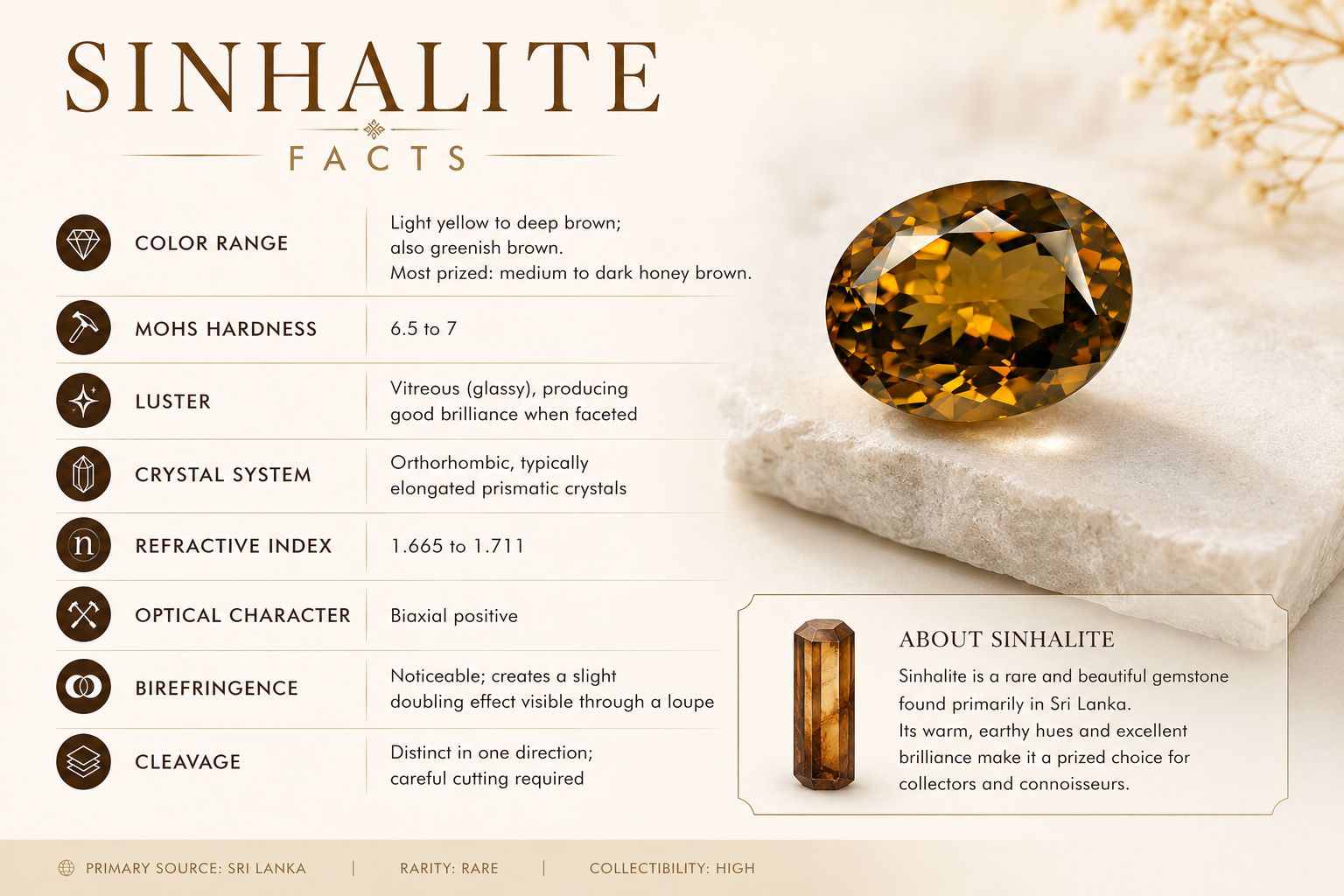
The refractive index of sinhalite, ranging from 1.665 to 1.711, sits remarkably close to that of peridot, which is precisely why the misidentification lasted so long. The key differentiator, beyond chemical analysis, is birefringence. Sinhalite’s double refraction creates a visible doubling of back facets when viewed through a loupe, a subtle but telling characteristic. Combined with its orthorhombic crystal structure and chemical composition, these optical clues allow trained gemologists to separate sinhalite from peridot with confidence.
Color and What Drives It
The warm yellowish brown to greenish brown palette of sinhalite comes down to trace amounts of iron within the crystal structure. These iron impurities absorb specific wavelengths of light, producing the characteristic earthy tones the stone is known for. Darker, more saturated stones with a rich honey brown hue are generally the most sought after, while very light or nearly colorless specimens command less interest from the collector market.
Where in the World Is Sinhalite Found?
“Sri Lanka does not just lend sinhalite its name. It remains the heartbeat of sinhalite production, producing the finest and most prized specimens known to gemology.”
GIA Graduate Gemologist Perspective
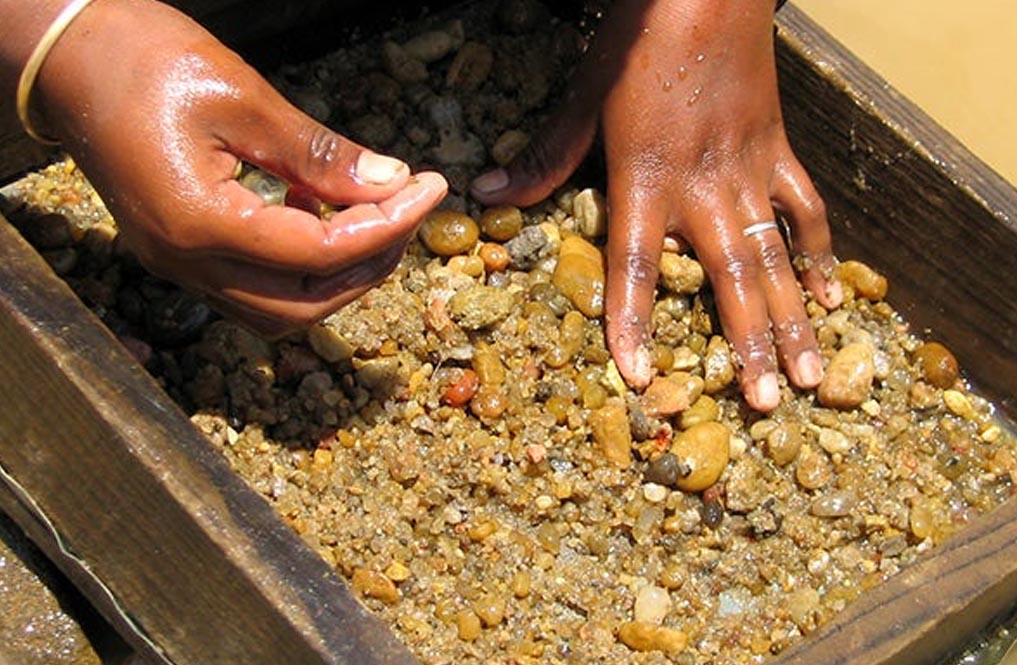
Sri Lanka, specifically the gem-rich Ratnapura region (whose name literally translates to City of Gems), is the primary and most significant source of sinhalite in the world. The alluvial gem gravels of Ratnapura have been yielding extraordinary stones for centuries, and sinhalite is very much part of that legacy. Stones from this origin tend to display the deeper, warmer honey brown tones that collectors prize most.
Myanmar, formerly Burma, has emerged as a secondary source, producing specimens that are generally a touch lighter in tone than their Sri Lankan counterparts. Given Myanmar’s reputation for producing exceptional rubies, sapphires, and spinel, it is not surprising that sinhalite turns up there as well.
Smaller, commercially insignificant deposits have been reported in Madagascar, Tanzania, and certain locations within the United States. However, none of these sources produce material in quantities that make any real impact on the market. For practical purposes, Sri Lanka and Myanmar are the only sources that gem buyers and collectors need to follow closely.
Cutting and Fashioning: A Job for Skilled Hands
Cutting sinhalite is not a task for an apprentice. The combination of moderate hardness, distinct cleavage in one direction, and strong birefringence means that an inexperienced cutter can quickly turn a fine rough specimen into a chipped disappointment. Skilled lapidaries need to orient the stone carefully before the first wheel touches it, taking into account both the cleavage plane and the optical axis to maximize brilliance while minimizing the risk of fracture.
The most popular cuts for sinhalite are oval, cushion, and emerald cuts. These shapes make the most of the stone’s color depth and allow light to move through it beautifully. Round and pear shapes are possible but tend to generate more waste from the rough, making them less economical. When the material is translucent rather than fully transparent, cutters sometimes produce cabochons instead, which have their own quiet appeal and can look remarkably elegant in vintage-inspired settings.
Treatments and Enhancements: Largely Untouched
This is where sinhalite earns considerable respect in a gem market that sometimes feels saturated with heated, irradiated, and fracture-filled stones. Sinhalite is rarely treated or enhanced in any way. Its natural color is appealing without intervention, and the gem’s chemical structure does not respond well to the heat or chemical treatments commonly applied to other stones.
The result is that almost all sinhalite specimens available on the market today are natural and untreated. For collectors who insist on stones in their original state, this is a significant advantage. It is also a point worth highlighting to any buyer who has grown weary of navigating the complex treatment disclosures required for rubies, emeralds, or many sapphires.
Why Untreated Matters to Collectors
- Natural color requires no heat treatment or chemical enhancement to appeal
- Crystal structure does not respond favorably to standard gem treatments
- Virtually all market specimens are unenhanced, a rare distinction in today’s gem trade
- No need for complex treatment disclosures, simplifying buying and selling transactions
- Untreated status is highly prized by GIA-trained gemologists and serious collectors
Identifying Sinhalite: How Gemologists Confirm the Stone
Given the long history of confusion between sinhalite and peridot, accurate identification is an important topic for anyone buying or selling this stone. Visual inspection alone is not sufficient. The two gems share similar color ranges and very close refractive indices, meaning that even experienced jewelers can be fooled without proper testing.
A refractometer reading is the logical first step. Sinhalite’s RI range of 1.665 to 1.711 overlaps with peridot’s range, so the refractometer narrows the field but does not conclusively separate them. The next step is examining the birefringence under a loupe; sinhalite’s doubling effect is typically quite distinct. Chemical analysis using a spectrometer or X-ray fluorescence will confirm the borate composition and settle any remaining uncertainty. The orthorhombic crystal system, visible under proper mineralogical examination, provides additional confirmation.
For high-value specimens or any stone where origin matters, a laboratory certificate from a respected institution such as the GIA, Gübelin Gem Lab, or SSEF is always advisable.
Market Value and Pricing: What Sinhalite Is Worth Today
The sinhalite market is not large, but it is active among those who know the stone. Because it has not entered mainstream commercial jewelry in any significant way, pricing is less standardized than for sapphires or rubies, and values can vary depending on where you shop and who you are dealing with.
High-quality sinhalite typically trades in the range of $100 to $500 per carat. This may seem modest compared to fine colored stones, but it reflects the niche nature of the market rather than any deficiency in the gem itself. Larger stones above five carats in fine quality are quite rare and will command premiums that push well beyond that range.
The factors that most strongly influence value are consistent with other colored gemstones. Color saturation and tone matter most, with deep honey brown and rich greenish brown tones at the top of the desirability scale. Clarity is the second major consideration, with eye-clean stones fetching meaningfully higher prices than included material. Origin plays a role as well, and Sri Lankan provenance can add a premium for collectors who follow origin closely.
“Sinhalite’s relatively accessible price point compared to its genuine rarity makes it one of the better value propositions in collector-grade gemstones available today.”
Jewelry Applications and Care
Sinhalite’s hardness of 6.5 to 7 on the Mohs scale places it in a reasonable range for jewelry use, though it requires more thoughtful handling than sapphire or diamond. It works well in earrings, pendants, and brooches, where contact with hard surfaces is minimal. Rings are possible but benefit from protective settings, ideally bezels or halo designs that shield the girdle from knocks and abrasion during everyday wear.
The warm honey and greenish brown tones of sinhalite complement both yellow gold and rose gold exceptionally well, and the stone sits beautifully in vintage-inspired settings that echo its historical connection to Sri Lanka’s long gem-trading tradition.
Caring for Your Sinhalite
Cleaning sinhalite is straightforward. Warm water, a drop of mild dish soap, and a soft brush are all you need. Rinse thoroughly and dry with a lint-free cloth. Ultrasonic cleaners are best avoided, as the vibrations can stress the cleavage planes. Steam cleaning is also inadvisable. Keep sinhalite away from household chemicals, bleach, and prolonged exposure to direct sunlight or high heat, all of which can affect the surface over time. Store it separately from harder stones to prevent scratching.
The Future of Sinhalite in the Gem Market
There is something genuinely exciting about a gemstone that remains underappreciated in the broader market. It means that collectors and jewelers who discover sinhalite now are entering a space before the crowd arrives. The stone’s combination of genuine rarity, natural untreated status, captivating color, and rich provenance story gives it real long-term appeal.
As more people look beyond the classic five colored stones for distinctive pieces that carry a story, sinhalite is well positioned to attract serious attention. It will likely never become a mainstream gem in the way that tanzanite did in the 1990s, partly because supply is simply too limited to support a mass market. But within the collector community and among designers who work with unusual stones, its profile is growing.
For anyone building a collection of rare gems with strong provenance and geological significance, sinhalite deserves a serious look.
Final Thoughts
Sinhalite is a gem that rewards curiosity. It has a history of mistaken identity that is genuinely interesting. It comes from one of the world’s most celebrated gem-producing nations. It is almost always untreated. It is available at price points that allow serious collecting without the budgets required for top-quality sapphires or rubies. And it looks beautiful in the right setting.
The fact that most people have never heard of it is not a weakness. For collectors who appreciate rarity, it is precisely the point.