
The Hidden Power of Obsidian Rocks: Why This Natural Glass Is More Valuable Than You Think
Obsidian rocks are some of the most fascinating natural materials on Earth. At first glance, they look like smooth, shiny black stones, but there is much more beneath the surface. From ancient tools to modern surgical blades, obsidian has played a surprising role in human history and science.In this article, you will discover what obsidian really is, how it forms, its unique colors, and why it is still used today.
What Is Obsidian?
Obsidian is a type of igneous rock, which means it forms from molten rock. What makes it special is how quickly it cools. When lava cools extremely fast, the atoms do not have enough time to form crystals. Instead, they freeze in place, creating a smooth, glass-like material.
Because of this, obsidian is often called volcanic glass rather than a true mineral. Scientists describe it as a mineraloid since it lacks a crystalline structure.
Key Characteristics of Obsidian:
1. Smooth and glassy texture
2 Breaks with sharp edges
3. No visible crystals
4. Forms from rapid cooling lava
How Obsidian Forms
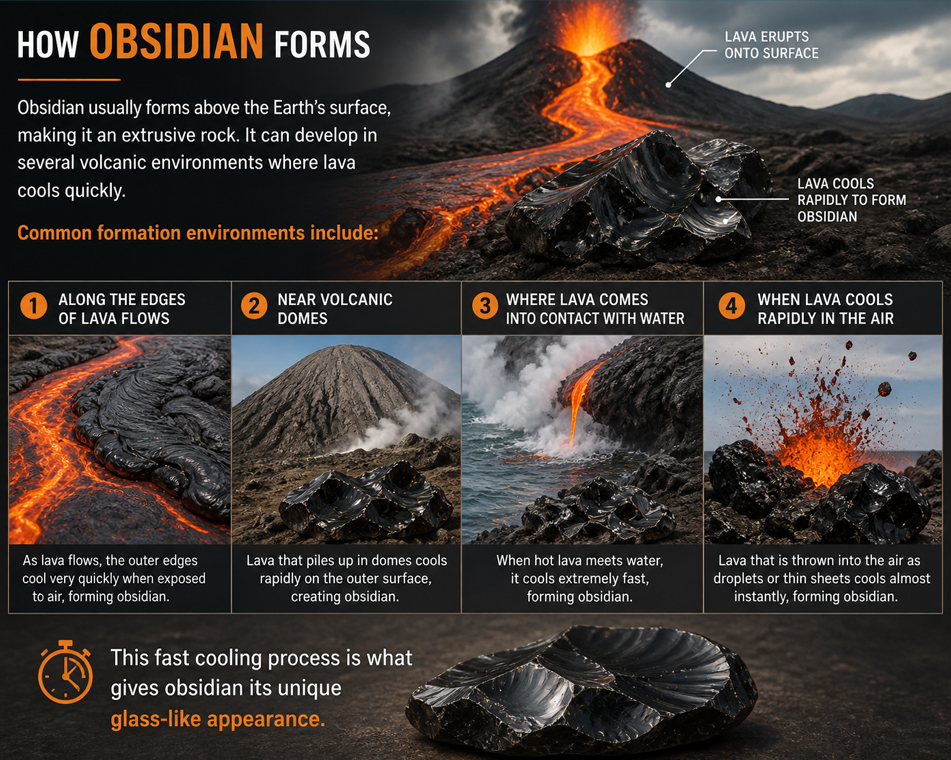
Obsidian usually forms above the Earth’s surface, making it an extrusive rock. It can develop in several volcanic environments where lava cools quickly.
Common formation environments include:
- Along the edges of lava flows
- Near volcanic domes
- Where lava comes into contact with water
- When lava cools rapidly in the air
This fast cooling process is what gives obsidian its unique glass-like appearance.
Colors of Obsidian
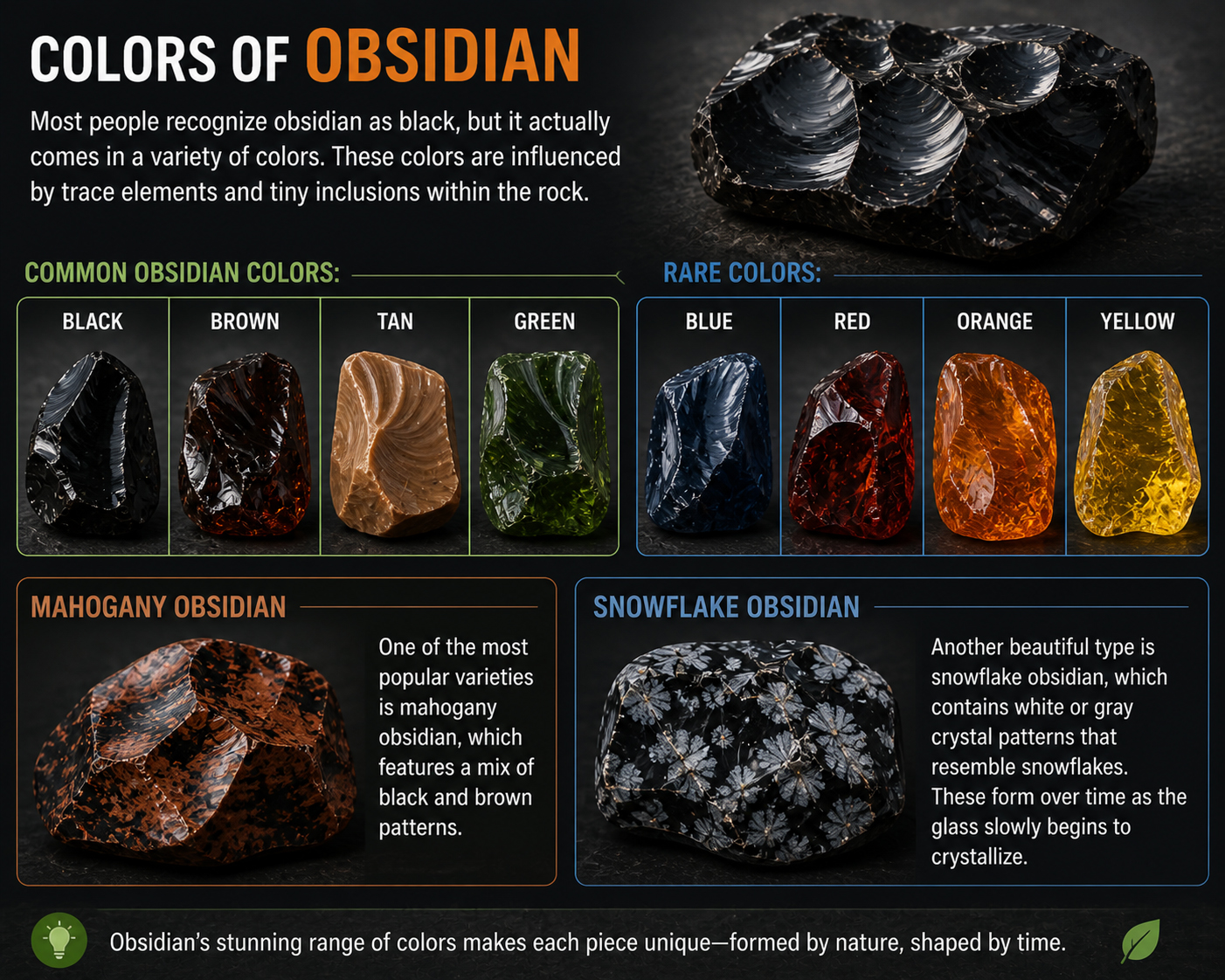
Most people recognize obsidian as black, but it actually comes in a variety of colors. These colors are influenced by trace elements and tiny inclusions within the rock.
Common Obsidian Colors:
- Black
- Brown
- Tan
- Green
Rare Colors:
- Blue
- Red
- Orange
- Yellow
One of the most popular varieties is mahogany obsidian, which features a mix of black and brown patterns.
Another beautiful type is snowflake obsidian, which contains white or gray crystal patterns that resemble snowflakes. These form over time as the glass slowly begins to crystallize.
Why Obsidian Changes Over Time
Even though obsidian looks solid and stable, it is actually chemically unstable. Over long periods, it begins to change. Instead of transforming evenly, small areas within the rock start to crystallize. This creates unique patterns like the snowflake effect mentioned earlier.
Because of this instability, very old obsidian is rare. Natural processes such as weathering, heat, and environmental exposure gradually break it down.
Where Obsidian Is Found
Obsidian is found in regions with recent volcanic activity. Since it does not last forever in its original form, deposits are usually only a few million years old or younger.
You can find obsidian in volcanic regions around the world, including:
- North and South America
- Iceland
- Japan
- Parts of Africa
Ancient Uses of Obsidian
Obsidian has been used by humans for thousands of years. Its ability to break into extremely sharp edges made it one of the earliest materials used for tools.
Common Ancient Uses:
- Knives
- Arrowheads
- Spear points
- Scrapers
Early humans discovered that obsidian could be shaped into precise cutting tools, making it incredibly valuable in daily life.
Obsidian in Modern Surgery
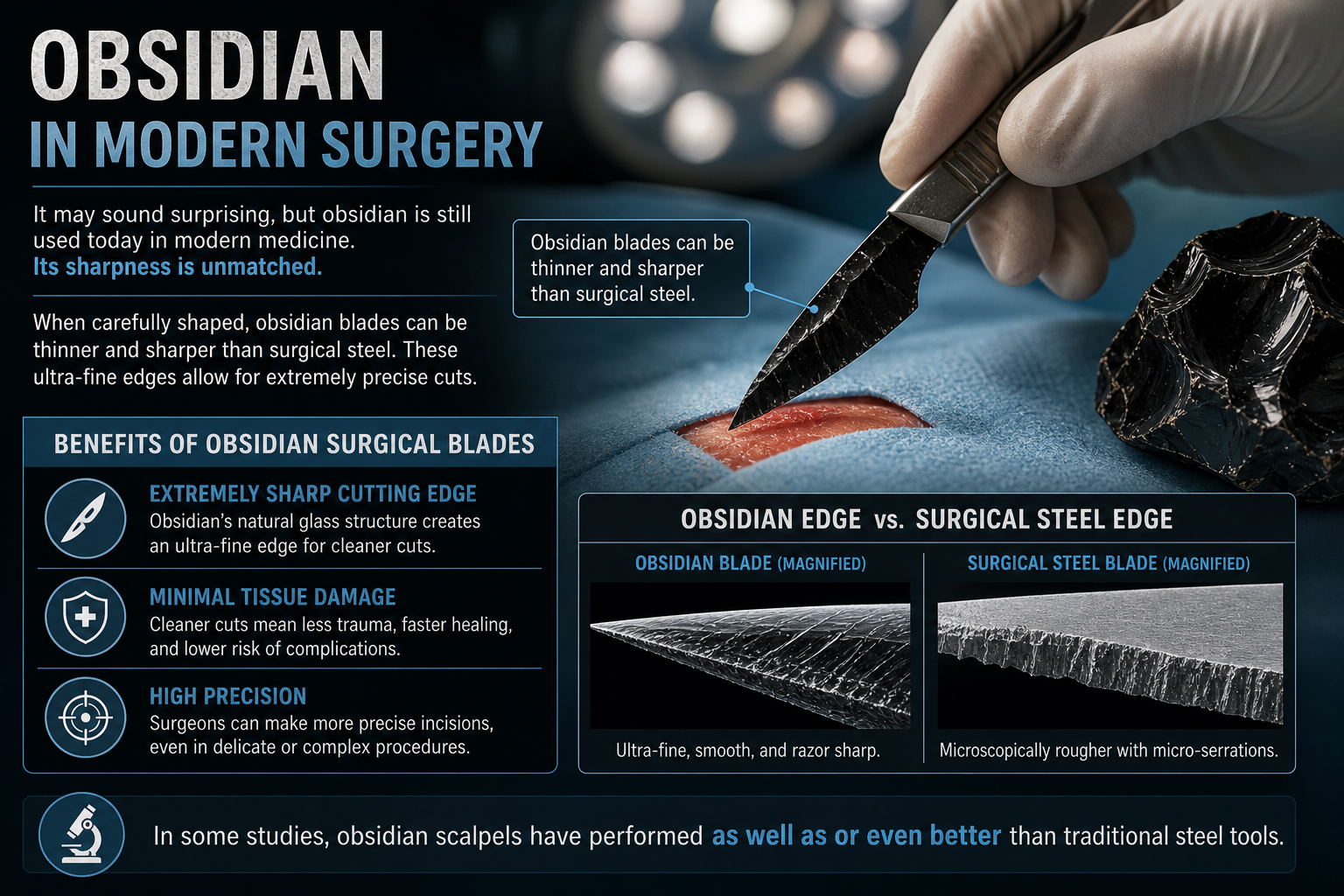
It may sound surprising, but obsidian is still used today in modern medicine. Its sharpness is unmatched.
When carefully shaped, obsidian blades can be thinner and sharper than surgical steel. These ultra-fine edges allow for extremely precise cuts.
Benefits of Obsidian Surgical Blades:
- Extremely sharp cutting edge
- Minimal tissue damage
- High precision
In some studies, obsidian scalpels have performed as well as or even better than traditional steel tools.
Obsidian as a Gemstone
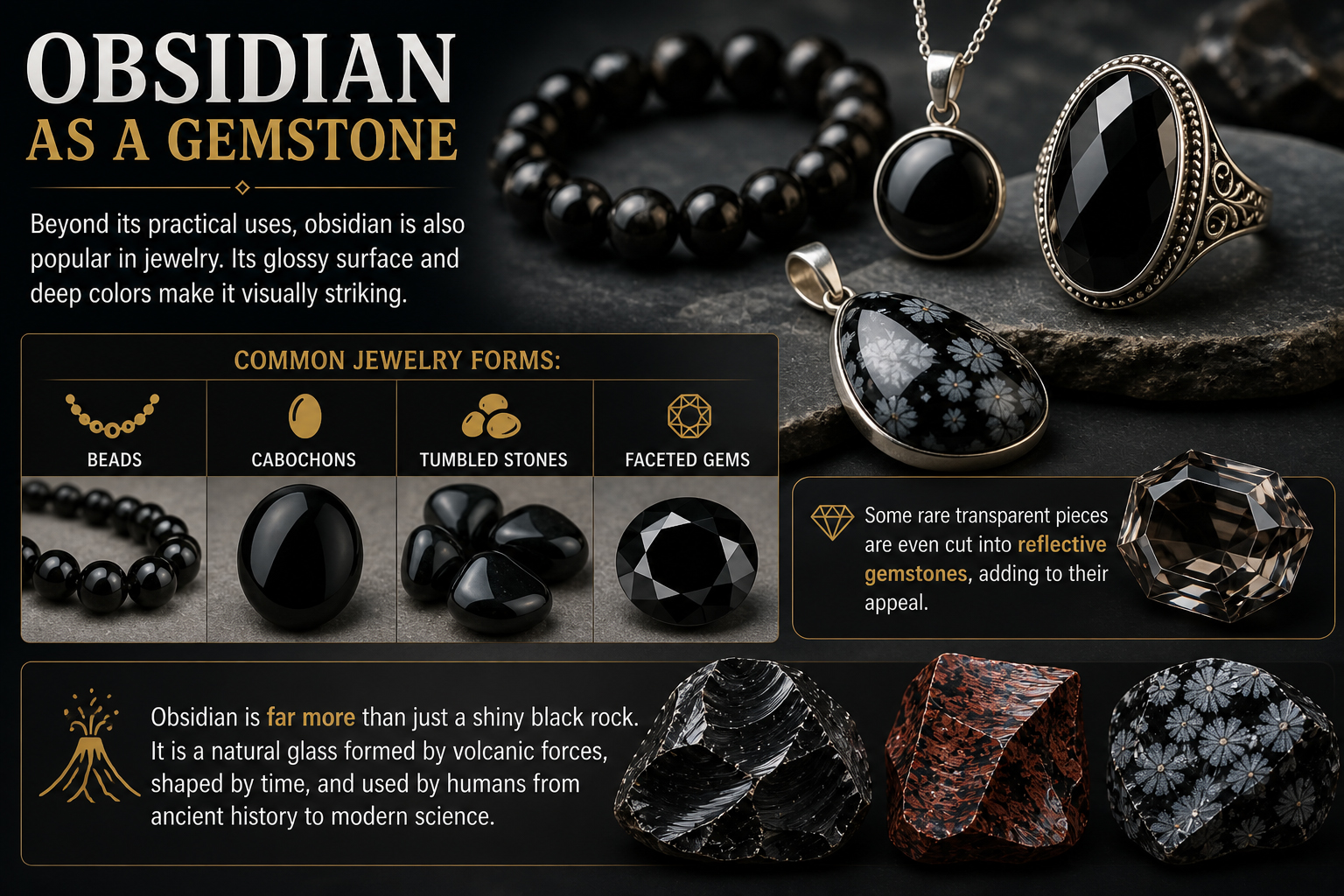
Beyond its practical uses, obsidian is also popular in jewelry. Its glossy surface and deep colors make it visually striking.
Common Jewelry Forms:
- Beads
- Cabochons
- Tumbled stones
- Faceted gems
Some rare transparent pieces are even cut into reflective gemstones, adding to their appeal.
Obsidian is far more than just a shiny black rock. It is a natural glass formed by volcanic forces, shaped by time, and used by humans from ancient history to modern science.
Whether it is crafted into tools, used in surgery, or worn as jewelry, obsidian continues to prove its value in surprising ways.
If you ever come across a piece of obsidian, you are not just holding a rock. You are holding a piece of Earth’s fiery past shaped into something both beautiful and powerful.