
The Mohs Scale Explained
devised the scale
1 (talc) to 10 (diamond)
than corundum (9)
relative gem hardness
Few tools in gemology are as elegant, as enduring, or as misunderstood as the Mohs scale. Devised in 1812 by German mineralogist Friedrich Mohs, this simple ladder of ten minerals has guided gem cutters, lapidaries, jewellers, and collectors for over two centuries. It is the first thing a gemology student learns and the last thing an experienced dealer stops thinking about.
But here is where most people go wrong: they confuse hardness with toughness, assume the scale is linear when it most definitely is not, and think that because a diamond sits at the top, nothing can damage it. All three assumptions are wrong — and understanding why is what separates a casual gem enthusiast from someone who truly knows their stones.
Hardness vs Toughness: A Critical Distinction
In everyday language, hard and tough mean much the same thing. In gemology, they describe two entirely different physical properties — and confusing them is one of the most common and costly mistakes a buyer or jeweller can make.
Hardness is what the Mohs scale actually measures: a gem or mineral’s ability to resist scratching. A harder material will scratch a softer one. That is the entire basis of the test.
Toughness describes something quite different — a mineral’s ability to resist chipping, cracking, and breakage under impact or stress. A material can be extraordinarily hard but still shatter if struck correctly. And this is exactly where diamond’s most surprising weakness is hiding.
“Diamond is the hardest natural substance on Earth — but it is not the toughest. A well-placed hammer blow can split a diamond cleanly in two. Jade, by contrast, will simply bounce.”
Diamond’s crystal structure is octahedral, giving it four distinct planes of cleavage. These planes are significantly weaker than the rest of the crystal, and diamond has a strong tendency to break along them — a property that diamond cutters exploit deliberately when cleaving rough diamonds, but one that also means a diamond ring struck sharply against a hard edge can chip or fracture.
Jade — specifically jadeite jade — tells the opposite story. It rates only 6.5 to 7 on the Mohs scale, comfortably below diamond’s 10. But jadeite’s interlocking crystal structure absorbs and deflects impact rather than directing it along cleavage planes. The result is a gem that is genuinely tougher than diamond by any practical measure, and one that has been used for weapons and tools throughout human history precisely because of that toughness.
Fascinating Fact
Ancient Mesoamerican civilisations — the Olmec, Maya, and Aztec — valued jadeite above gold. They fashioned it into ceremonial axes, masks, and jewellery not just for its beauty, but because its extraordinary toughness meant it would not shatter under the stress of being worked with primitive tools. They had no Mohs scale, but they understood toughness perfectly.
Who Was Friedrich Mohs?
Friedrich Mohs was a German mineralogist born in 1773, trained at the Mining Academy of Freiberg and later employed by an Austrian banker to catalogue a private mineral collection — an assignment that would inadvertently change the course of geology forever. In 1812, working to create a practical, reproducible system for identifying minerals in the field, he published his hardness scale in Versuch einer Elementar-Methode zur naturhistorischen Bestimmung und Erkennung von Fossilien (an attempt at an elementary method for identifying minerals — the title alone nearly justifies his fame).
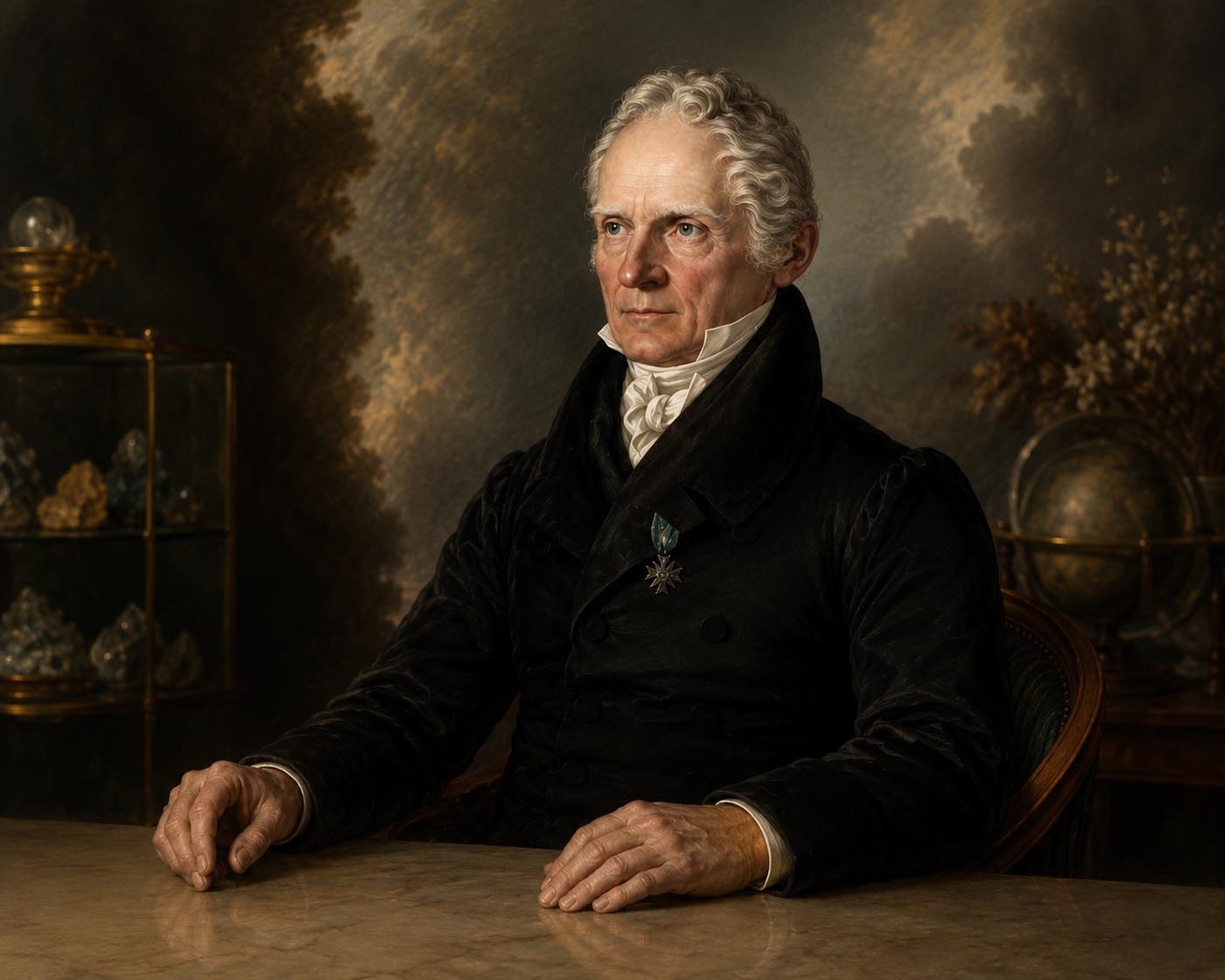
Mohs was not the first person to observe that minerals scratch one another — the Greek philosopher Theophrastus had noted this around 300 BC in his treatise on stones, and the Roman scholar Pliny the Elder built on that work centuries later in his encyclopaedic Natural History. But Mohs was the first to formalise it into a numbered, reproducible comparative scale that anyone with a mineral collection could apply in the field. That practical utility is why it survived while other competing systems did not.
Historical Note
Theophrastus — Aristotle’s successor as head of the Lyceum in Athens — wrote On Stones around 300 BC. It is one of the earliest surviving scientific texts on mineralogy. He described gems being scratched by other gems, and noted that some stones resisted working with tools better than others. Pliny the Elder cited him extensively when writing Natural History in the first century AD, more than 300 years later. The chain of knowledge from Theophrastus to Mohs to the GIA spans over 2,300 years of continuous gemological inquiry.
The Mohs Scale: All 10 Minerals
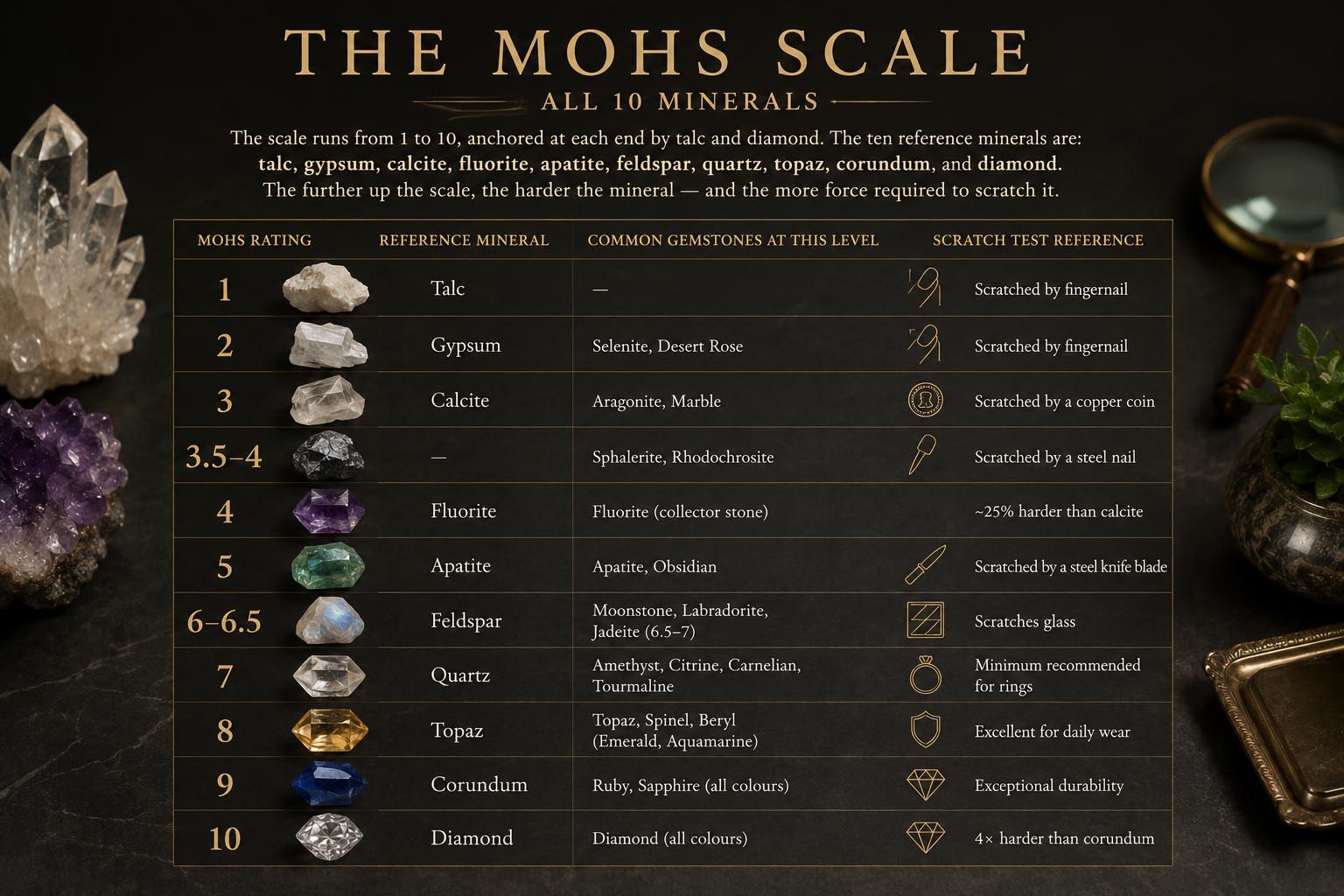
The scale runs from 1 to 10, anchored at each end by talc and diamond. The ten reference minerals are: talc, gypsum, calcite, fluorite, apatite, feldspar, quartz, topaz, corundum, and diamond. The further up the scale, the harder the mineral — and the more force required to scratch it.
| Mohs Rating | Reference Mineral | Common Gemstones at This Level | Scratch Test Reference |
|---|---|---|---|
| 1 | Talc | — | Scratched by fingernail |
| 2 | Gypsum | Selenite, Desert Rose | Scratched by fingernail |
| 3 | Calcite | Aragonite, Marble | Scratched by a copper coin |
| 3.5–4 | — | Sphalerite, Rhodochrosite | Scratched by a steel nail |
| 4 | Fluorite | Fluorite (collector stone) | ~25% harder than calcite |
| 5 | Apatite | Apatite, Obsidian | Scratched by a steel knife blade |
| 6–6.5 | Feldspar | Moonstone, Labradorite, Jadeite (6.5–7) | Scratches glass |
| 7 | Quartz | Amethyst, Citrine, Carnelian, Tourmaline | Minimum recommended for rings |
| 8 | Topaz | Topaz, Spinel, Beryl (Emerald, Aquamarine) | Excellent for daily wear |
| 9 | Corundum | Ruby, Sapphire (all colours) | Exceptional durability |
| 10 | Diamond | Diamond (all colours) | 4× harder than corundum |
Memory Device
Need to memorise the ten Mohs minerals in order? Two mnemonics have helped generations of geology students. The first: “Tall Girls Can Flirt And Fergie Quite Tempts Cowboys Daringly” (Talc, Gypsum, Calcite, Fluorite, Apatite, Feldspar, Quartz, Topaz, Corundum, Diamond). The second, for those who prefer absurdist imagery: “12 Gigantic Cows Fought Against 50 Quick Turtles Causing Disaster.” Neither will make you the most popular person at a dinner party, but both will get you through a gemology exam.
The Scale Is Not Linear — And That Matters
One of the most important and least understood facts about the Mohs scale is that its numbers do not represent equal steps in actual hardness. The scale is ordinal — it tells you the order, but not the magnitude of the difference between each step.
Consider this: fluorite at 4 is approximately 25% harder than calcite at 3. That sounds like a meaningful jump. But diamond at 10 is more than four times harder than corundum at 9 — the two minerals that sit right next to each other at the very top of the scale. The difference in absolute hardness between 9 and 10 is vastly larger than the difference between any other two adjacent steps.
This non-linearity was a known limitation in Mohs’s own lifetime, and he acknowledged that the scale was built only from minerals that were readily available and commonly used at the time. The gaps between values are, in his own framing, somewhat arbitrary. Modern absolute hardness measurements using the Vickers or Knoop hardness tests produce very different numbers — but the Mohs scale endures because of its simplicity and field practicality.
“The Mohs scale is convenient, but not perfect. Diamond is not just one point harder than corundum — it is in a different universe of hardness entirely. The numbers do not tell you that.”
The Gemstone That Outsparkles Diamond
Sphalerite is one of gemology’s most dramatic examples of the trade-off between hardness and optical beauty. At only 3.5 to 4 on the Mohs scale, it is soft by any standard — significantly below the 7 generally considered the minimum for a ring stone suitable for daily wear. It also has perfect cleavage in six directions, making it enormously challenging to cut and polish without the stone splitting under the lapidary’s wheel.
And yet. Sphalerite possesses a dispersion — the ability to split white light into its spectral colours, creating what we see as “fire” — that surpasses diamond. A master-cut sphalerite, typically yellow to reddish-orange, throws rainbow flashes that have to be seen to be believed. It is a collector’s gem precisely because it demands the very best craftsmanship to produce a finished stone at all.
Did You Know?
Sphalerite’s dispersion value is 0.156 — compared to diamond’s 0.044. That means sphalerite breaks white light into its rainbow components at more than three times the rate of diamond. A beautifully cut sphalerite is one of the most visually spectacular objects in the mineral world, which makes the challenge of actually cutting one without shattering it all the more extraordinary for any skilled lapidary.
What Hardness Means for Buyers and Jewellery Wearers
Understanding the Mohs scale has direct, practical implications for anyone buying or wearing gemstone jewellery. Dust and airborne grit are predominantly composed of quartz particles — which rate 7 on the Mohs scale. Any gem that rates below 7 will, over time, be abraded by everyday dust, losing its polish and developing a scratched, dull appearance. This is why gemologists consistently recommend a minimum of Mohs 7 for stones set in rings, which receive the most exposure to abrasive contact.
| Jewellery Type | Recommended Minimum Hardness | Why |
|---|---|---|
| Engagement Rings / Daily Wear Rings | Mohs 7+ | Constant contact, dust abrasion, knocks |
| Earrings | Mohs 5+ | Low abrasion exposure; minimal contact wear |
| Pendants / Necklaces | Mohs 5–6 | Some friction against clothing |
| Collector / Display Stones | Any Rating | Handle with care; store individually |
Important Warning
Never use the Mohs scratch test on finished gemstones or mounted jewellery. Testing by scratching a new pair of earrings, a polished faceted gem, or any set stone risks permanent surface damage. The scratch test is a field test for raw mineral specimens — not a diagnostic tool for evaluating finished pieces. For identification of cut gems, always consult a gemologist with proper laboratory equipment.
Why Lapidaries Study Hardness First
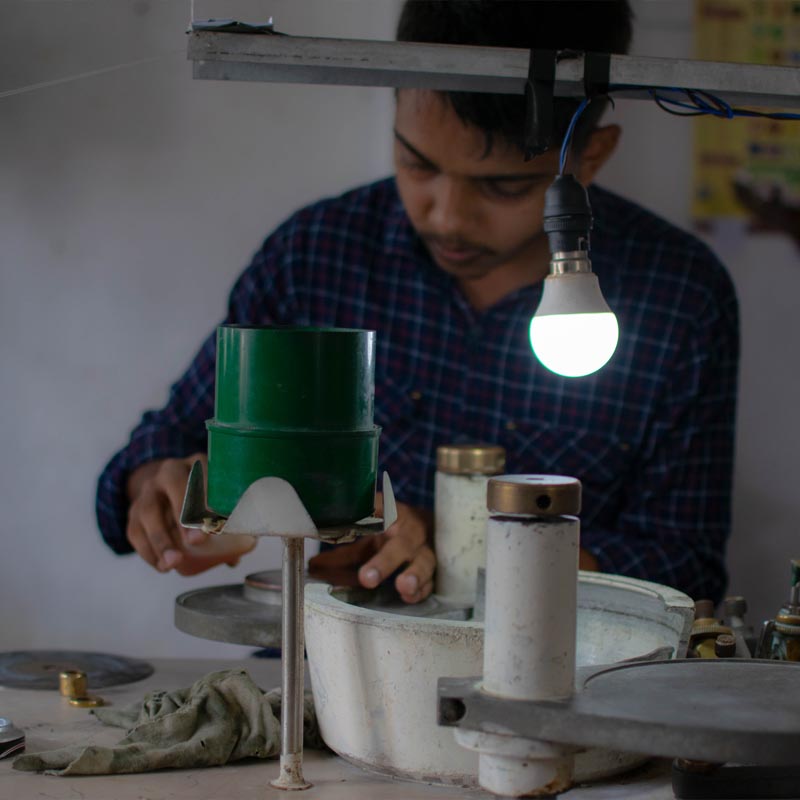
For a lapidary — the craftsperson who cuts and polishes gemstones — understanding a gem’s physical properties is not academic background knowledge. It is the foundation of every practical decision made at the wheel. Knowing the hardness, cleavage direction, toughness, and thermal sensitivity of a stone determines how it can be oriented on the dop stick, what grinding wheels and abrasives are appropriate, how much pressure can safely be applied, and how the stone will behave when warmed by the heat of polishing.
Sphalerite, with its six cleavage directions and low hardness, is a vivid illustration of how a gem’s physical properties define what is possible with it. Working it requires tools, techniques, and patience far beyond what a standard sapphire or quartz would demand — yet the results, when executed well, are extraordinary. In this sense, the Mohs scale is not just a classification system. It is a practical guide to what each stone will and will not tolerate.
“Knowing a gemstone’s physical properties is not optional knowledge for a lapidary — it is the difference between a masterwork and a pile of expensive fragments on the workshop floor.”
Frequently Asked Questions
Is a Mohs 10 diamond unbreakable?
No. Diamond is the hardest natural substance on Earth, meaning nothing can scratch it except another diamond. But hardness and toughness are different properties. Diamond has four cleavage planes and can be split or chipped by a sharp impact in the right direction. Diamond cutters have exploited this for centuries when cleaving rough diamonds — but it also means a diamond ring struck hard against a concrete surface can fracture.
Why is jade considered tougher than diamond if it rates lower on the Mohs scale?
Toughness is resistance to breakage, not resistance to scratching. Jadeite jade’s interlocking crystal structure — technically called a granular microcrystalline texture — absorbs and deflects impact energy rather than directing it along cleavage planes. Diamond, by contrast, has well-defined cleavage directions that act as structural weak points under sudden force. The Mohs scale only measures one property. Toughness requires a completely separate assessment.
What is the minimum Mohs hardness for an engagement ring stone?
Gemologists consistently recommend Mohs 7 or above for any stone set in a ring intended for daily wear. This is because ambient dust — the kind that settles on surfaces and accumulates in clothing fibres — is largely composed of quartz (Mohs 7). Any stone softer than 7 will be gradually abraded by everyday dust contact, losing its polish over months and years. Sapphire (9), ruby (9), and spinel (8) are among the most durable choices for engagement rings.
Can I use the Mohs test at home to identify gems?
You can use reference materials — a fingernail (2.5), a copper coin (3), a steel knife blade (5.5), and a piece of glass (5.5–6) — to estimate a raw mineral specimen’s hardness in the field. However, this test should never be performed on finished or faceted gemstones, polished specimens, or any piece of jewellery. It will leave permanent scratches. For definitive identification of a cut gem, a professional gemologist using refractometer, polariscope, and spectroscope testing is the correct approach.
Is the Mohs scale still used by professional gemologists today?
Yes — it remains a fundamental reference in gemological education, trade description, and practical jewellery recommendations. The GIA includes Mohs hardness in all standard gem descriptions, and lapidaries use it daily in deciding how to approach cutting and polishing. More precise absolute hardness measurements (Vickers, Knoop) exist for laboratory and industrial purposes, but the Mohs scale endures because of its simplicity, universal familiarity, and practical utility in the field — exactly as Mohs intended in 1812.
About the Author
Written by an experienced gem trader with hands-on experience across mineral collecting, specimen cleaning, and fine jewellery care. For more in-depth gemstone guides, explore GemGuidebook.com.
“Ethics and beauty go hand in hand. Discover Sri Lanka’s finest responsibly sourced gemstones at Airagems.com.“